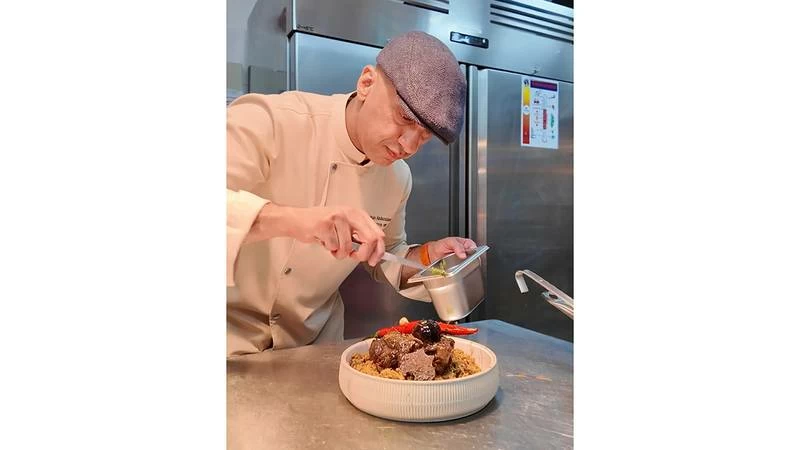
Dubai: Between a ring where he learned patience, and a kitchen where he found space to face a different kind of challenge, Emirati chef Nabhan Al Ali charted his course away from traditional methods in the culinary world.
Just as boxing taught him that falling is not the end of the fight, the failure of his first experience in the restaurant world led him to return with greater determination and passion to preserve the legacy of Emirati cuisine.
Chef Nabhan has launched many restaurants and worked to preserve Emirati recipes. From his sessions with grandmothers to document recipes, to his endeavour to present local dishes in a contemporary style that preserves their identity, he is waging a different battle, the goal of which is to keep the flavours of the homeland present on the tables, and to make its stories reach the world.
The first steps in the culinary world were fraught with determination, as Chef Nabhan recalls: “I have always combined sports and cooking. In 2009, I established my first restaurant, but the project failed, and this made me turn to establishing a sports project, especially since that is my main field. Then in 2014 I returned to the kitchen, because I wanted to compensate for my loss and the first failure.”
He added about his story with the culinary world: “I established a group of restaurants, especially those specialising in healthy food, but then I began to notice a gap in the sector, especially with regard to the absence of Emirati food from many luxury hotels, so I felt it was my duty to develop our recipes and dishes in order to preserve and protect our rich heritage.”
One book to preserve history
His recipe collection will be supported by artificial intelligence, to help those who are not familiar with Emirati cooking in preparing distinctive recipes, dishes and tables. Picture credit: SuppliedChef Nabhan is concerned about Emirati cuisine and the need to preserve it. Therefore, he worked on gathering people from all over the country, and sat with elderly mothers and grandmothers, and prepared traditional recipes with them, with the aim of collecting them in one book, to be a reference for Emirati food, explaining that he has collected approximately 90% of Emirati recipes in one edition.
He revealed that it will not be a paper book, but will be available through electronic platforms, and will be supported by artificial intelligence, to help those who are not familiar with Emirati cooking in preparing distinctive recipes, dishes and tables. He noted that there is a difference in recipes between one emirate and another, as in some areas, balaleet is prepared with onions, and in others, it is not used, and there are places that use curry in madrouba and others that do not include it in the recipe, but in the end the flavours do not differ much.
Despite his long career in the culinary world, Chef Nabhan has not given up on sports. He maintains his exercise routine and healthy lifestyle to this day, believing that the culinary field requires the mindset of a boxer who loves a challenge, as the kitchen is not an easy place to work in and involves many challenges.
He believes that boxing taught him endurance, challenge, and how to remain steadfast until the very last breath in order to reach the goal, noting that in the ring there is an opponent, but in the kitchen the chef is in competition with himself, and this is the most difficult competition, as he put it.
He noted that his failure in 2009 was a turning point in his career, because he does not like to lose, and his loss was the door through which he tried to learn more about Emirati cuisine and about restaurant management in general.
Emirati cuisine deserves attention
Chef Nabhan continued: “Emirati cuisine needs more attention in order to preserve its heritage, as nothing reflects the culture of any country more than local dishes and entering the world of cooking. The details of the cuisine allow us to learn about the history of foods and spices, as well as the movement and course of trade over time.”
He noted that Emirati cuisine, for example, has been greatly influenced by Indian spices, which have become part of the local culinary culture.
He stated that he is currently working on establishing standards and guidelines for Emirati cuisine, enabling anyone of any nationality to cook the dishes and understand the secrets of their ingredients. He sees himself as a custodian of Emirati cuisine more than just a chef, because what he presents is a message and a culture, and every meal has a story. He praised the country's efforts in preserving heritage, particularly regarding the decisions mandating the inclusion of Emirati dishes in hotel buffets, which will contribute to preserving local cuisine.
Although the Emirati chef works to present local dishes in a contemporary way, he believes in the importance of preserving their identity and presenting them in a luxurious manner so that all nationalities can enjoy them. He stressed that excessive modernisation of dishes is “a kind of distortion,” because it should be done in a way that raises the level of the authentic dish and preserves its identity.
He added: “When anyone eats my dishes, I hope they remember the history of the Emirates, because every meal carries a legacy and a story.”
Chef Society
Chef Nabhan Al Ali expressed his delight at being at the Athar restaurant, which recently opened as part of the Chef Society in Mirdif City Centre, Dubai. He noted that this initiative – which brought together many chefs and food cultures from around the world in one place – is unique and allows tourists to learn about dishes from around the world, not just the local Emirati heritage. He expects the idea to resonate and be implemented in multiple centres across the country.