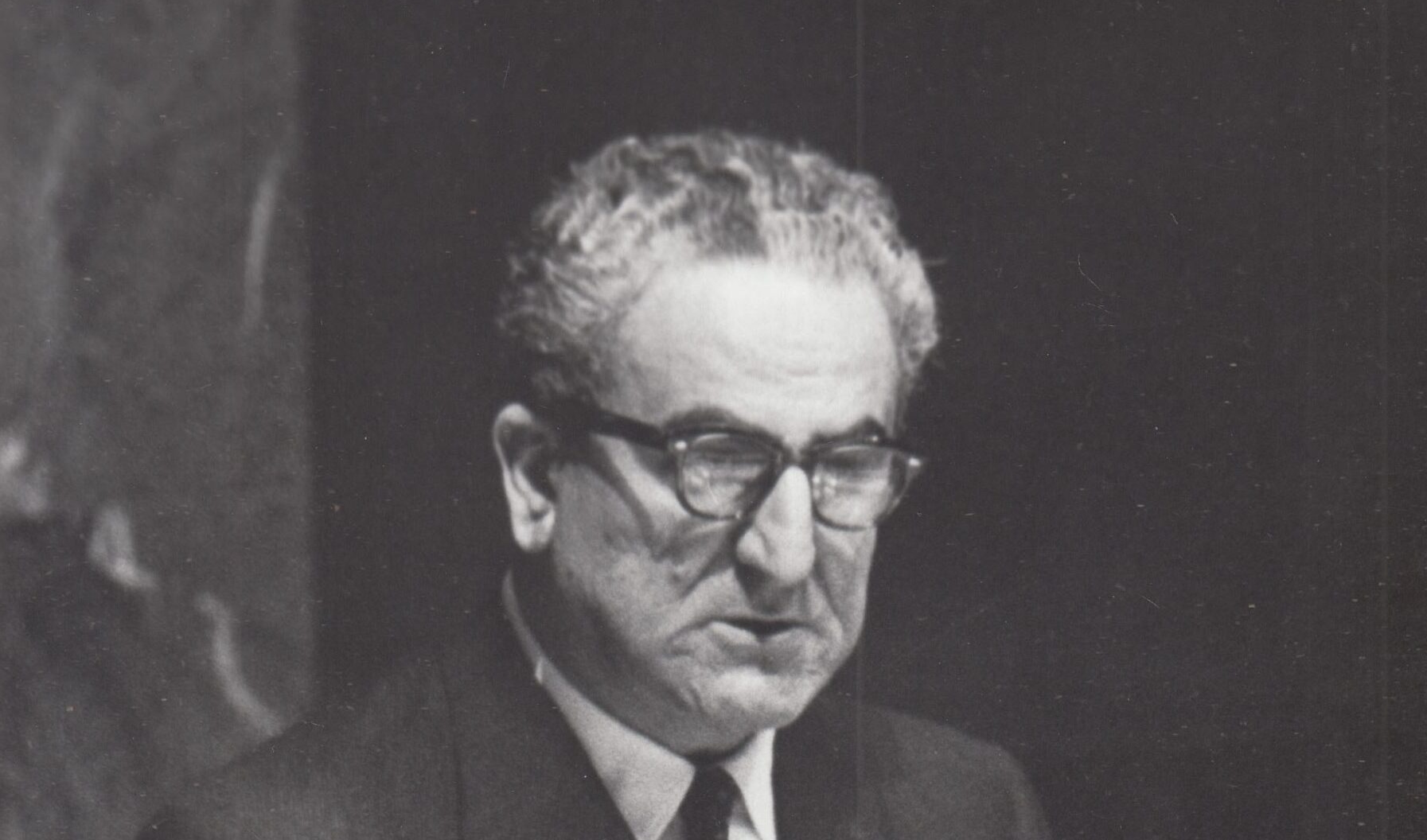
Charles Malik viewed Israel’s establishment as the beginning of a dangerous transformation in the Middle East. He believed its impact would extend beyond the seizure of Palestinian land to reshaping relations between the Arab world and the rest of the world. In his view, the Zionist threat would not end with the declaration of a state or its admission to the United Nations. The power behind its creation would seek to turn its military and diplomatic superiority into political and economic domination. This was the central argument of a report he dated August 5, 1949, republished by Dar An-Nahar in 2002 with an introduction by Ghassan Tueni. Malik’s analysis is significant because he recognized early that the Palestinian Nakba exposed a broader Arab crisis. He believed the defeat could not be explained by the outcome of battles alone. It reflected the political and social structures that had made such a defeat possible. Fragmentation, weak institutions, improvised policies and the failure to pursue reform could make the loss of Palestine repeat itself in different forms across the Arab world. Defending Palestine, therefore, meant defending the Arabs’ right to determine their own future. The belief that each country could survive on its own was an illusion that left all of them vulnerable. This understanding went beyond the view that the conflict was merely a border dispute that could be settled by formalizing armistice lines. As the excerpts from Malik’s report suggest, Israel represented a base from which power could accumulate and influence expand. That expansion could take the form of direct occupation or operate through economic ties, diplomacy and alliances. In either case, the decisive question was how much independence Arab societies would lose in making their own decisions, and how much power Israel would gain to dictate terms. One of the report’s most important arguments concerns the possibility of controlling the region by making Israel an obligatory intermediary between the Arab world and the West. If relations with the outside world, access to support and development projects all depended on accepting Israel’s role, recognition of that role would become a condition imposed on Arab life itself. The issue would no longer be simply accepting Israel’s existence, but accepting its authority to shape regional interests and determine the region’s future. Malik also highlighted the political implications of economic projects. Aid, he argued, should not be measured by its financial value alone, but also by the conditions attached to it and the power relations it creates. A project presented as development could deepen dependency, while a plan marketed as a lifeline could leave its beneficiary less able to object. The central question is whether development strengthens a society’s ability to make its own choices or makes progress conditional on the approval of an external power. His message to Lebanon and the wider Arab world is that resisting domination requires protecting the land, safeguarding independent decision-making and building a society capable of defending its freedom. This perspective explains his warning about US policy. He saw the possibility that economic incentives for Arab countries could go hand in hand with efforts to consolidate Israel’s strategic superiority. Arabs might receive promises of prosperity while being asked to accept a regional order that undermined their rights. The danger lay in portraying sovereignty as an obstacle to development and political concessions as the natural path to stability and prosperity. Lebanon occupied a particularly sensitive place in Malik’s analysis. Its internal weakness could allow an external power to gain a foothold through a local faction that mistakenly believed foreign backing would give it an advantage over its domestic partners. His warning about a possible agreement between Israel and certain Lebanese groups revealed an early understanding of the link between domestic divisions and foreign intervention. Any faction that calls on a foreign power to strengthen its position risks exposing the entire country to dangers far beyond its own calculations. It can also trigger a chain of interventions and confrontations whose consequences are difficult to contain. This argument frames Lebanese patriotism as a responsibility to protect the country as a whole. No community can secure its future at the expense of national independence, nor can any sect rely on Israeli superiority as a lasting guarantee of its existence. Domestic calculations that ignore the nature of the power they invoke risk turning Lebanon’s internal divisions into instruments of a broader project. The deeper point in Malik’s analysis is the link between external threats and a country's vulnerability from within. He regarded reform as part of the struggle for liberation. Strong institutions, modern knowledge, responsible policies and cooperation that preserves independence were all essential. This approach makes it insufficient to condemn the enemy alone. Recognizing its hostility does not absolve societies of the responsibility to build their own resilience. The report’s lasting value lies more in its warnings than in any claim that it predicted every subsequent development. Malik outlined scenarios that depended on the continuation of Arab fragmentation and political paralysis, while leaving room for renewal. His message to Lebanon and the wider Arab world is that resisting domination requires protecting the land, safeguarding independent decision-making and building a society capable of defending its freedom. A project seeking to monopolize the region’s future must ultimately confront the determination of its peoples to remain masters of that future. This is an edited translation of an article originally published in Arabic.