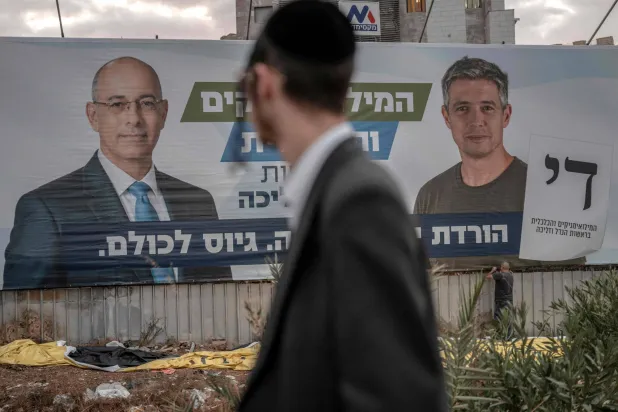
US President Donald Trump’s endorsement of Israeli Prime Minister Benjamin Netanyahu ahead of the October 27 election has given the ruling right-wing camp a boost. But whether it can reverse Netanyahu’s declining electoral fortunes remains uncertain. Netanyahu and his Republican allies had lobbied hard to secure Trump’s backing. According to Israel’s Channel 12 and Channel 13, White House officials struggled with the decision, holding numerous meetings with figures from Israel’s governing coalition and opposition and requesting in-depth opinion polls. Aware that Trump dislikes backing losers and prefers strong leaders, Netanyahu assembled a team to convince Washington that his electoral prospects had improved. Meanwhile, the opposition’s “change camp” sought to discourage US interference. Former Prime Minister Yair Lapid met officials from both American parties, promising that an alternative Israeli government would maintain closer ties with the Trump administration and cooperate more fully in implementing his peace plan. But Washington’s proposal for a unity government bringing together Netanyahu and his main rival, Gadi Eisenkot, exposed divisions and hesitation within the opposition. Its apparent reluctance to cooperate reportedly frustrated Trump and contributed to his decision to endorse Netanyahu. (FILES) US President Donald Trump greets Israeli Prime Minister Benjamin Netanyahu as he arrives at the West Wing of the White House in Washington, DC on September 29, 2025. (Photo by Jim WATSON / AFP) Can Trump revive Netanyahu’s fortunes? The president’s backing is likely to resonate primarily with right-wing voters rather than the Israeli electorate as a whole, reflecting sharply divided attitudes toward him. In 2024, Trump enjoyed support from 60% to 72% of Israelis. By early 2025, 61% considered him the preferred US president for advancing Israel’s interests, including 96% of right-wing respondents, 52% of centrists, 30% of left-wing voters and 32% of Arab citizens. Confidence in Trump rose to 75% in March 2026 before plunging to 26% that summer following Washington’s agreement with Tehran. Surveys also found that 81% of left-wing respondents, 73% of centrists and 65% of right-wing voters believed Israel’s security was not a priority for him. Israeli media have frequently greeted Trump’s shifting positions with skepticism and even ridicule. His clashes with Netanyahu have particularly unsettled the right. In 2025, when the Israeli leader opposed Washington’s proposed negotiations with Iran, Israeli outlets reported that Trump had demanded he fall into line with the American approach, telling him that he and his government were now part of Trump’s plan, not the other way around. In June 2026, Axios and CNN reported details of a heated telephone conversation in which Trump allegedly shouted at Netanyahu over strikes on Beirut and attempts to obstruct US-Iran negotiations. According to those accounts, the American president called him completely “crazy,” claimed to have kept him out of prison and accused his policies of turning public opinion against Israel. With Likud holding 36 seats in the Knesset but polling at just 18 to 21, Netanyahu hopes Trump’s intervention will persuade disillusioned right-wing supporters to return to the party. Its impact may be limited, however, among voters who view Trump unfavorably, including some on the right and a larger share of the political center. Much of the Israeli media, described in the analysis as aligned with the opposition’s “change camp” and the country’s entrenched establishment, has played down the announcement. Some commentators have even called it a bad omen, pointing to Trump’s previous support for Hungary’s Viktor Orban and Brazil’s Jair Bolsonaro, both of whom subsequently lost elections. What might Netanyahu offer in return? Israeli political analysts have advanced several theories about what Trump hopes to gain from supporting the prime minister. One is that Netanyahu pledged to strike Iran independently, with US forces providing assistance from a distance rather than participating directly, as they did in June. Trump appeared to reinforce that interpretation by describing Netanyahu as the only Israeli prime minister both willing and able to attack Iran. He added that while he could order US strikes himself, he had no interest in doing so. Another explanation centers on Washington’s interest in a post-election unity government involving Netanyahu and Eisenkot, who would share the premiership. Under this scenario, Trump wants a strong, predominantly right-wing Israeli government reflecting the country’s political majority and capable of making far-reaching decisions to implement his peace plan. The endorsement could therefore give Netanyahu an opportunity to stage an “October surprise,” borrowing a term from US politics for a late campaign development capable of dramatically reshaping electoral prospects. But the Israeli leader must still prove that he can turn Trump’s support into votes. Netanyahu moved quickly to capitalize on the announcement Sunday evening, posting a video on Telegram urging Israelis to pay close attention to the president’s remarks. Fifteen minutes later, he released another recording describing Trump’s endorsement as unconditional and emphasizing their partnership. Netanyahu credited their cooperation with major achievements against Iran and its regional allies, claiming they had dealt crushing blows to both and removed the immediate threat of nuclear bombs. He also portrayed Trump as determined to work alongside him to complete the task of eliminating the Iranian threat within the next two years, or possibly sooner. Vehicles drive past an election billboard featuring images of Israeli Prime Minister Benjamin Netanyahu (R) and Yashar party leader Gadi Eisenkot (L) in Ramat Gan near Tel Aviv, Israel, 18 October 2026. EPA/ABIR SULTAN Opposition caught off guard Opposition leaders were stunned by the announcement. An associate of Lapid disclosed that people close to Trump had indicated earlier Sunday that the president did not intend to interfere in Israel’s election. The official suggested that the endorsement might have been compensation for Netanyahu after Trump refused to launch another attack on Iran. Eisenkot’s allies were divided over whether to ignore the development to preserve good relations with Washington or publicly suggest that Netanyahu had offered concessions in return, potentially including advancing Trump’s Gaza plan and accepting a Palestinian state. Speaking at Tel Aviv University on Sunday evening, Eisenkot expressed appreciation for Trump’s contribution to Israel’s security and the hostage agreement but insisted that Israeli voters alone would choose their government. He added that the US administration would be able to cooperate with any government elected in Israel.