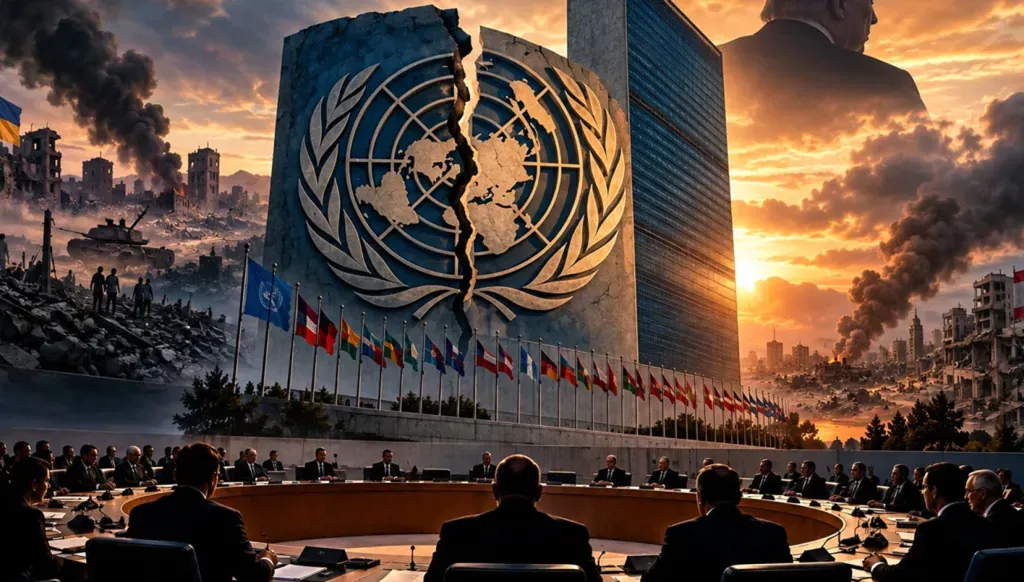
Can the United Nations survive in a world where major powers are unable to agree on ending wars, the organization cannot ensure that its resolutions are implemented, and new international initiatives are emerging to challenge its role? Eighty-one years after its founding, the question is no longer limited to the UN’s ability to reform its institutions. It concerns the future of the international order established in 1945 and whether it can endure amid accelerating geopolitical shifts.
On October 24, 1945, the UN Charter entered into force, establishing an international system designed to prevent a repeat of World War II, protect state sovereignty, and regulate international relations according to common rules. Today, the organization faces a multifaceted crisis in which wars overlap with paralysis at the Security Council, declining commitment to international law, and a financial crisis threatening the continuity of its operations.
The problem extends beyond institutional performance to a more fundamental question: Can a system built on an outdated balance of power manage a world in which the distribution of power and the nature of conflicts have changed? Are reforms enough to save it, or are alternatives already taking shape?
The Security Council, which is responsible under Article 24 of the Charter for maintaining international peace and security, is the clearest manifestation of the crisis. In 2024, the veto was used eight times against seven draft resolutions, marking the highest annual rate since 1986. In 2025, the number of vetoes fell to four, while the Council adopted only 44 resolutions, its lowest total since 1991. Just 61.4% of the resolutions were adopted unanimously.
In Ukraine, Russia’s veto blocked resolutions concerning the war and Ukrainian sovereignty. In Gaza, draft ceasefire resolutions were stalled, while international divisions prevented a decisive response to the war in Sudan. The deadlock continued in 2026, with Russia and China exercising their vetoes over the Middle East crisis and the Strait of Hormuz.
The General Assembly has sought to limit the repercussions of the veto through Liechtenstein’s 2022 initiative, which requires a debate on its use within ten working days, as well as the French-Mexican initiative calling for restrictions on its use in cases involving mass atrocities. However, these mechanisms lack the authority to overturn a veto or impose alternative binding resolutions.
The Security Council’s crisis goes beyond its inability to adopt resolutions; it also struggles to ensure the implementation of those it passes, particularly resolutions concerning states’ sovereignty and national security.
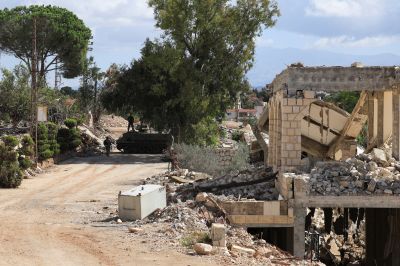
Lebanon offers a case in point. Resolution 1559, adopted in 2004, called for the disbandment and disarmament of all Lebanese and non-Lebanese militias. Resolution 1680, adopted in 2006, reaffirmed the need to implement its provisions, while Resolution 1701, adopted following the July War, emphasized the implementation of the Taif Agreement and the two earlier resolutions. It also called for the disarmament of all unauthorized armed groups.
Nearly two decades later, the presence of weapons outside the authority of the Lebanese state remains one of the most prominent manifestations of the failure to implement these resolutions, with implications for sovereignty and the state’s exclusive authority over military and security decisions.
This experience raises a fundamental question: What practical value do international resolutions concerning state sovereignty and the exclusive control of weapons by legitimate authorities have if the Security Council cannot ensure their implementation?
Conflicts in Ukraine, Sudan, and other countries affected by war reveal a widening gap between legal principles and the mechanisms for enforcing them. Protecting civilians, respecting borders, and prohibiting the use of force are fundamental principles of the international order, yet they collide with the interests and strategic calculations of major powers.
This crisis is accompanied by a decline in peacekeeping operations. UN missions have ended in Mali, Sudan, and Iraq, while the Security Council, under Resolution 2790, decided to extend the mandate of the United Nations Interim Force in Lebanon (UNIFIL) for the final time, until the end of 2026, paving the way for its orderly withdrawal.
In July 2026, Secretary-General António Guterres proposed a review of peace operations, calling for greater emphasis on mediation, preventive diplomacy, and flexible missions rather than large-scale traditional deployments. The success of this approach, however, remains contingent on the international community’s political will to address conflicts.
A Financial Crisis Threatening the Organization’s Continuity
The United Nations is facing a liquidity crisis as member states delay payment of their contributions. This comes amid a 23.1% decline in official development assistance in 2025, to approximately $174.3 billion, alongside a sharp drop in US contributions.
The crisis has been exacerbated by the mechanism requiring unused funds to be returned to member states, even when the failure to spend them results from delayed contributions. This prompted the General Assembly to amend the mechanism for calculating these balances on a trial basis in 2026.
In March 2025, Guterres launched the UN80 Initiative, which focuses on improving administrative efficiency, reviewing thousands of mandates, and reorganizing programs and agencies. The initiative includes cutting jobs and relocating activities to lower-cost centers.
Administrative reform alone, however, cannot resolve the crisis in political decision-making or the Security Council’s inability to enforce respect for international law.
Trump and the Board of Peace: The Beginning of a Parallel International Order?
The UN’s crisis has taken on an additional dimension under US President Donald Trump, who has criticized the organization’s effectiveness and reduced US engagement in several international institutions, favoring arrangements based on direct interests and the ability to deliver rapid results.
In January 2026, Trump launched the Board of Peace in Davos. Initially established as part of arrangements for Gaza, the initiative subsequently expanded its stated ambitions to include addressing other international conflicts.
Although Trump has emphasized that the board would work in cooperation with the United Nations, its powers and leadership structure have raised concerns that it could evolve into a parallel framework to the Security Council, particularly as some European countries have expressed reservations about joining it.
The significance of the initiative extends beyond Gaza. It presents a model for managing conflicts through agreements led by a major power, outside the UN’s traditional mechanisms of representation and voting.
This is taking place alongside the rise of blocs such as BRICS and the Group of Twenty (G20), as well as the expansion of regional and economic alliances. However, these frameworks do not yet possess the global legitimacy or legal universality enjoyed by the United Nations.
Three Scenarios for the Future of the International Order
The organization appears to face three possible scenarios: successful reforms that strengthen the role of the General Assembly and improve peace operations; continued gradual decline, with strategic decisions shifting to parallel alliances; or the erosion of the effectiveness of the multilateral system in favor of power politics and deterrence.
These possibilities take on particular significance as Guterres’s term ends on December 31, 2026, and a new secretary-general assumes office in early 2027, amid mounting financial, institutional, and political challenges.
Eighty-one years on, the United Nations may continue to exist with its institutions and Charter intact, even as its ability to exert influence diminishes. But the survival of the organization does not necessarily mean the survival of the international order it was established to protect.
This is where the real problem lies, raising an important question: Will the United Nations be able to restore its capacity to regulate international relations and enforce respect for its rules, or has the world been fundamentally shaken by the declining legitimacy of institutions in favor of the power of states and alliances?
Eighty-one years after the founding of the United Nations, the question is no longer whether the organization can survive, but whether the international order it embodies remains viable—or whether a world in which the equations of power are forged behind closed doors is rewriting all the rules beyond the walls of the UN.