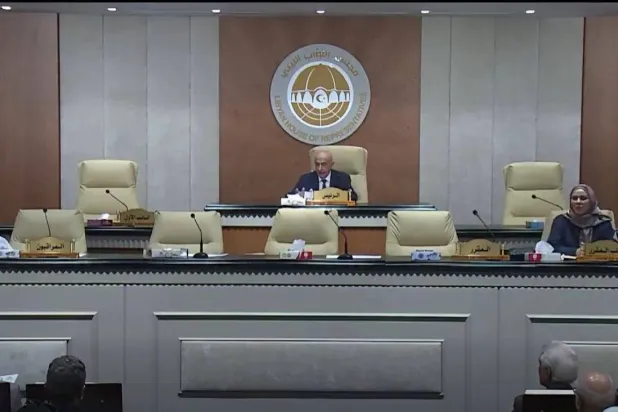
A push to change the rules of Libya’s parliament and rotate its leadership has put a question to the Benghazi-based chamber: Can lawmakers unseat Speaker Aguila Saleh after nearly 12 years at its helm? The effort has also raised questions about why a bloc opposed to Saleh’s “unilateral decision-making” is acting now, whether its campaign is tied to the “4+4” agreement, and whether that deal can be carried out. The agreement is seen as a possible route out of Libya’s political divide through a unified executive authority that would lead the country to elections within two years. The lawmakers opposing Saleh say they will press on with efforts to “reform parliament and change its leadership.” They say they were blocked from holding a session on the issue in the middle of last week when the chamber’s Benghazi headquarters was closed on its leadership’s orders. Issam al-Jehani, a prominent member of the bloc, said its 86 lawmakers could meet in any Libyan city where they could carry out their duties. Their aim was “neither a conspiracy nor an attempt to take Saleh’s seat,” he said, but reform in response to Saleh’s unilateral decisions and determination to stay in office. Other political figures say the campaign could splinter and fade. Its momentum, they argue, depends on the balance of power in eastern Libya and on regional pressure. Lawmaker Ali al-Takbali expects it to lose steam. He told Asharq Al-Awsat that a similar call in March for a session to change parliament’s rules came to nothing. He also questioned whether Saleh’s opponents could keep enough lawmakers together to hold a session to remove him. They may unite over a grievance, al-Takbali said, but become harder to assemble once they return home, particularly if some reconsider their position because of personal interests or tribal ties. Fellow lawmaker Montaser al-Hassi warned that some members’ actions could split parliament. Lawmakers have the right to amend its rules, he said, but must do so through legal channels. Libya has long been divided between two governments: the interim Government of National Unity led by Abdulhamid al-Dbeibah in Tripoli, and Osama Hammad’s parliament-appointed government, which runs the east and some southern cities and is backed by Libyan National Army commander Field Marshal Khalifa Haftar. Under the “4+4” agreement reached late last month by representatives of the Government of National Unity and the Libyan National Army under UN auspices, a new presidential council and unified government would prepare the country for general elections within two years. Some observers and political figures say regional countries regard Saleh’s continued leadership as a safeguard against a split in the legislature, which they describe as the only institution to have remained intact through Libya’s institutional divisions. Analyst Hossam Fnish linked the turmoil in parliament to the “4+4” deal. He said the reform bloc’s insistence on changing the rules before holding sessions would delay incorporating the agreement into Libya’s constitutional declaration, hindering a deal that could lead to elections and end the divide. The UN mission, he said, prefers to incorporate the agreement through a constitutional amendment before seeking Security Council endorsement. Fathi al-Shibli, head of the Voice of the People party, questioned the reform bloc’s motives. Complaints about Saleh making decisions alone and sessions going ahead without a quorum had circulated for years without drawing objections from lawmakers, he said. That, in his view, lent weight to suspicions that the dispute was a struggle between blocs backed by powerful interests, rather than a drive for reform. Al-Shibli expects Saleh to remain in office until the UN mission calls for a constituent council to replace parliament and the High Council of State to implement the “4+4” agreement. He said both bodies oppose a change to Libya’s political landscape. Political analyst Mohammed Mahfouz likewise described the parliamentary dispute as a contest between powerful groups in eastern and western Libya, each seeking to show the international community that it can control the political scene. Saleh’s hold on his position rests on two factors, Mahfouz told Asharq Al-Awsat: whether he and his allies can absorb the current anger, and whether regional and Western countries support him. Saleh’s two deputies may help him contain the challenge, Mahfouz said, because they too could face replacement.