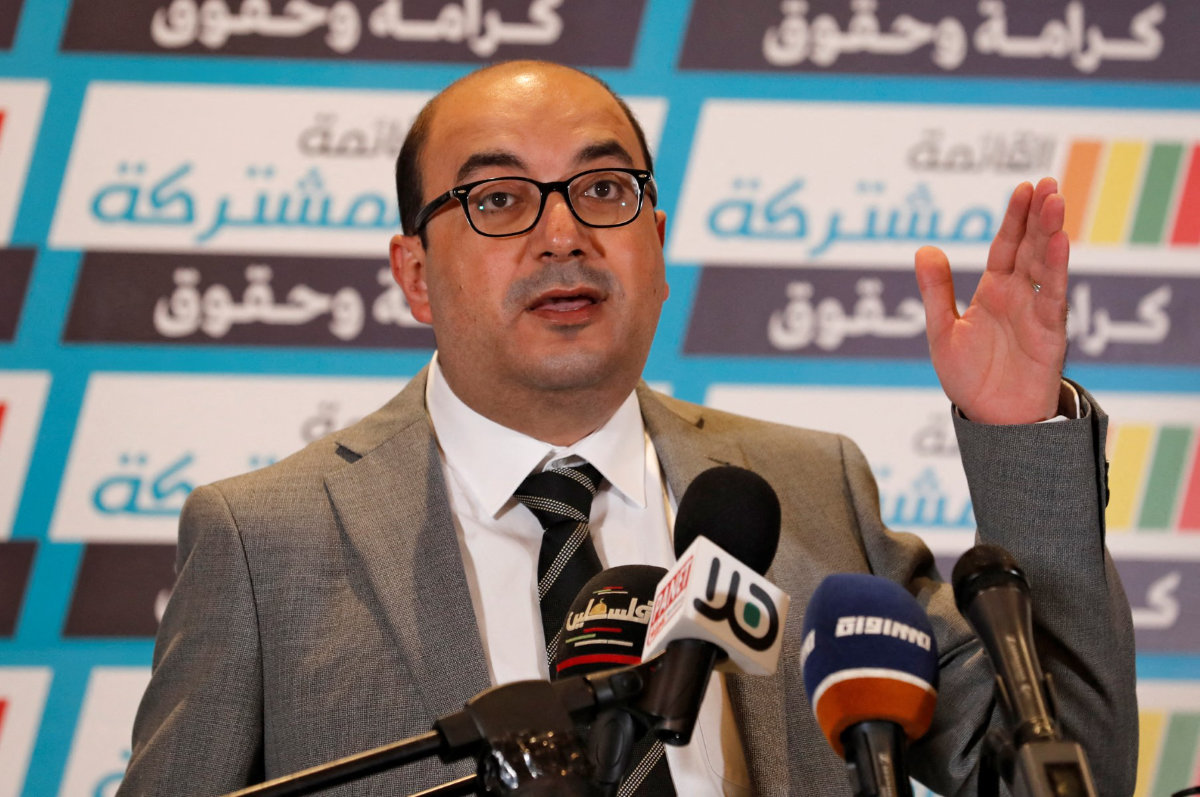
LONDON: If anyone were in any doubt as to who was behind the attempt this week to block veteran Arab politician Sami Abu Shehadeh from standing in next month’s Israeli general election, that doubt vanished on Friday afternoon when cell phones across Israel lit up with a recorded message from the far-right national security minister, Itamar Ben-Gvir.
“We promised that we would not allow the head of Balad, Sami Abu Shehadeh, to enter the Israeli Knesset — and that is what we did,” he boasted.
“Yesterday, following a High Court hearing, it was decided that Sami Abu Shehadeh would not be in the Israeli Knesset, thank God.”
In fact, that was not quite what happened; Shehadeh withdrew his candidacy before the Supreme Court could issue a ruling.
But Ben-Gvir was undeterred. His party, Otzma Yehudit, he added, “will continue to fight for national honor and for democracy in Israel. We will not allow terror supporters and those who glorify shahids (martyrs) to operate freely in the Israeli Knesset.”
And, Ben-Gvir pledged, “soon we will do the same to Ahmad Tibi,” who is one of the longest-serving Arab members of Israel’s parliament, “and Ofer Cassif,” a member of the left-wing Hadash party.
That has not happened, either. But, as Palestinian citizens of Israel realize all too well, so much depends on the outcome of the upcoming election that the Israeli far right is unlikely to stop trying to silence their voices.
“I received this voicemail,” Samah Wattad, a Palestinian journalist in Israel, told Arab News. “My husband received this call. My sister received this call. I know colleagues, journalists, who received this call.
“It is very clear that Ben-Gvir is going after us as a Palestinian community. Ben-Gvir’s dream is not to see any Arabs in the Knesset, or anywhere else.”
People are afraid, she said: “They have just turned out an elected leader of Palestinian Arab society, and I believe this is just the start. This government is watching closely what Palestinian Arabs are saying and how they are active politically and, to be honest, people are already afraid.
“I live here, I see how people are. They don’t want to speak about politics because after Oct. 7, we have seen that they will come after you for an article or something you posted 10 years ago.
“There is no room for any perspective that isn’t an Israeli Zionist one. Before Oct. 7, Israel wanted to be known as the only democracy in the Middle East. Now, they don’t care.”
Ever since it was formed in 1969, Israel’s Central Elections Committee has had the legal authority to disqualify both individual candidates and entire party lists from standing in Knesset elections. On Sept. 23, it voted to disqualify Shehadeh, one of Israel’s most prominent Arab politicians.
The committee is not an independent body. A majority of its 31 members represent parties that support Prime Minister Benjamin Netanyahu’s governing coalition.
Now, as Israel heads toward a parliamentary election on Oct. 27 that could bring an end to Netanyahu’s far-right government, the committee has moved to disqualify Arab party lists that, if allowed to run, could hold the balance of power.
Challenges against candidates and parties are nothing new in Israeli politics. It is also common for decisions by the Central Elections Committee to be overturned on appeal by the Supreme Court.
But this week, “normal” took a strange turn. Late on Thursday, the night before the Supreme Court was due to rule on Shehadeh’s appeal against his disqualification, he announced he was withdrawing his candidacy.
Controversially, Isaac Amit, the president of the Supreme Court, had publicly indicated that a majority of the nine justices appeared inclined to uphold the committee’s ruling. Shehadeh’s subsequent decision to withdraw was a tactical move based on that indication.
In the event, it might have been unnecessary. On Friday, the Supreme Court overturned the Central Elections Committee’s decisions to bar the Joint List of predominantly Arab parties, the Islamist Ra’am party led by Mansour Abbas, and Cassif, the Hadash lawmaker. Because Shehadeh had already withdrawn, the court did not rule on his case.
Ben-Gvir’s gloating message was therefore misleading. But Shehadeh’s withdrawal was nevertheless ultimately the result of the disqualification process initiated against him by Otzma Yehudit.
What happened is a complex story the roots of which stretch back to 1984, when Israel’s parliamentarians faced an embarrassing problem.
His name was Meir Kahane, a racist, ultra-Zionist extremist who had emigrated to Israel from the US in 1971, founded a party campaigning for the removal of Israel’s Arab population, and won a seat in the Knesset.
Kahane, who had been convicted of terrorism-related offenses in the US, was the founder of the militant Jewish Defense League and had been arrested repeatedly in Israel before his election.
In 1980, he was jailed over plans for armed attacks against Palestinians. While in prison, he wrote “They Must Go,” a manifesto advocating the expulsion of Israel’s Arab population.
The Central Elections Committee was asked to intervene. When it was found that Israel’s Basic Law did not provide grounds for removing Kahane, the law was amended in 1985 to include “incitement to racism” as a basis for disqualification.
Kahane was subsequently barred from running. In 1990, he was assassinated in New York by an Egyptian-born US citizen. His political ideology, however, lives on in the term “Kahanist,” which in contemporary Israeli politics is frequently applied to Ben-Gvir and his Otzma Yehudit party.
In 2002, the Basic Law was amended again, this time to include “support of armed struggle of an enemy State or of a terrorist organization against the State of Israel” as a disqualifying condition. It was this provision that Ben-Gvir’s party invoked in seeking the disqualification of Shehadeh.