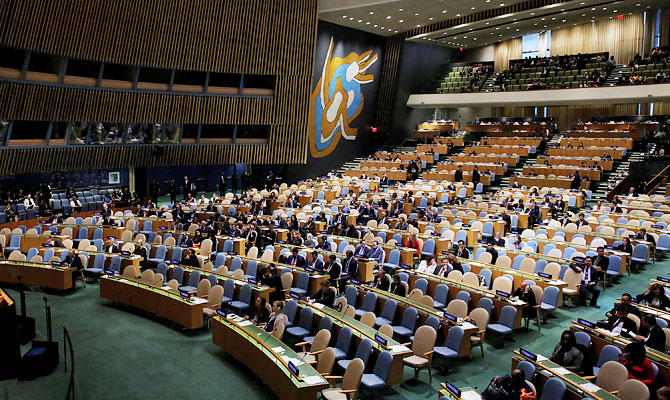
NEW YORK: World leaders are gathering for the high-level week of the 81st UN General Assembly as crises in the Gulf, Gaza and Sudan compete for diplomatic attention. The race to choose the next secretary-general adds to the pressures on an organization that one longtime UN watcher described as stuck in “an open-ended crisis.”
The assembly’s session has already opened, but the leaders’ general debate begins on Tuesday, with speeches scheduled through Sept. 26 and again on Sept. 28.
Inside UN headquarters, the mood is tense. “The mood before high-level week is always one of high stress, as we try to get everything organized,” UN spokesman Stephane Dujarric told Arab News.
The message Secretary-General Antonio Guterres wants heard, he said, is that the organization must confront overlapping crises at once — conflict, climate, technology and deepening inequality between and within countries, which he called “a very destabilizing factor” — while pushing member states to recommit to the UN’s founding values and modernize an institution still built for 1945.
“Reform is not a one-night stand,” Dujarric said. “It’s not a one-week stand. It’s a constant push.”
Despite a Gulf crisis analysts describe as massive in scale, diplomats interviewed said no dedicated high-level meeting on Iran or the wider standoff had been announced — an absence several diplomats and analysts called surprising.
Diplomats from several missions conceded the issue was “not really visible right now from the agenda.” One diplomat told Arab News the issue was “difficult to get a handle on” and said it was expected to feature prominently in meetings on freedom of navigation and the Strait of Hormuz.
Another diplomat said the Gulf crisis, despite being absent from the formal agenda, will be “built into” every other meeting on the agenda — a response one analyst dismissed as “a diplomatic answer.”
Richard Gowan, program director for global issues and institutions at the International Crisis Group, said he saw no indication of backchannel diplomacy between Washington and Tehran this year — “nothing like 2019,” he said, when a meeting between US President Donald Trump and his then-Iranian counterpart Hassan Rouhani nearly materialized.
Iranian officials, he said, are expected to use their platform “to make their case in terms of, firstly, the fact they are victims of aggression; secondly, the fact that their own acts of aggression are really acts of self-defense.”
Daniel Forti, Crisis Group’s head of UN affairs, said the more consequential diplomacy will happen not at the podium but among Gulf states themselves while their leaders are gathered in New York, and that “how the Gulf states individually and collectively conduct their quiet diplomacy next week will be quite integral.”
Forti recalled how leaders from eight Muslim-majority countries met Trump unannounced last year to push for a Gaza ceasefire — a push that ultimately led to the ceasefire the US president went on to broker.
The same meeting is set to take place again this year, while the usual meeting between the GCC and the Security Council has been taken off the agenda this year.
The only related gathering on the calendar is a Germany-World Food Programme event on food security, a far cry from the major US-led food security summit Washington convened in 2022 during the first year of the Russia-Ukraine war.
It is a gap Gowan called striking given “a massive global crisis in the Gulf” with “no real meeting focusing on the fallout.”
A senior UN official overseeing peace and security said the Security Council has been discussing splitting Iran-related discussions into separate tracks — one on the Strait of Hormuz, another on the Houthis — and was blunt about the limits of what New York can do: “Something’s got to give,” the official said.
Yemen, the official added, is now entangled in the broader Gulf crisis and “getting a lot worse,” with 73 UN national staff still held by the Houthis, some for more than three years.
The Palestinian issue will also draw a noticeably smaller spotlight than it did 12 months ago.
A French diplomat told Arab News the format of this year’s follow-up event on the two-state solution, jointly hosted by France and Saudi Arabia, is still being finalized.
But it is expected to be narrower than last year’s co-chaired gathering, likely without Israel and centered on shortcomings in implementing the New York Declaration: humanitarian access and governance in Gaza, conditions in the West Bank, and Palestinian Authority reform.
Gowan tied the lower profile to the Security Council-endorsed Board of Peace mechanism, which he said has left “quite a lot of UN member states” trying to “say less about Palestine and focus on other issues.”
Chaired by Trump, the Board of Peace is tasked under the Gaza peace framework with overseeing transitional governance and reconstruction in the territory.
British Prime Minister Andy Burnham is separately co-hosting a two-state meeting with French President Emmanuel Macron and Canadian Prime Minister Mark Carney, building on last year’s declaration and the 20-point peace plan.
And Germany is again co-hosting a Gaza reconstruction meeting with Egypt — with a diplomat acknowledging that the humanitarian situation “has not improved” and that reconstruction “is not happening yet.”
The senior UN official listed a string of further side events, including a gathering of the Organization of Islamic Cooperation and the Arab League on Jerusalem. And a meeting of the Norway-chaired Ad Hoc Liaison Committee, which coordinates international donor support for the Palestinians — evidence of an issue still generating activity even as its headline profile fades.
Sudan’s crisis, meanwhile, looks set to repeat a pattern that has held for three years running. The war pits the Sudanese army against the paramilitary Rapid Support Forces.