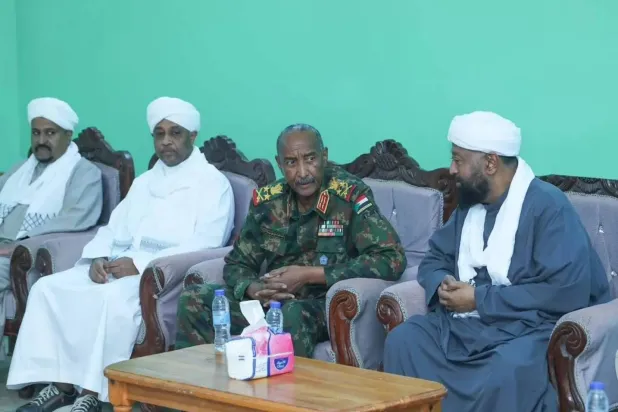
Sudan’s army chief Abdel Fattah al-Burhan downplayed advances by the Rapid Support Forces (RSF) and their allies in the Blue Nile region, urging residents not to fear an attack on the regional capital and vowing to fight until what he called the rebellion is defeated. His remarks came hours after the RSF-aligned Tasis alliance claimed control of five areas in Geissan, a day after announcing the capture of the Bau locality headquarters. Speaking in Khartoum on Friday evening while offering condolences over the death of Khatmiyya Sufi leader Mohamed Osman al-Mirghani, Burhan sought to reassure residents of Ad-Damazin, the Blue Nile capital. “Don’t be afraid,” he said, citing the army’s expulsion of RSF fighters from Khartoum as evidence of its ability to prevail. “They were sitting in the very house where I am speaking,” he added. “Wherever they enter, they will find themselves in a tunnel, in a trap they cannot escape.” Burhan said that the war remained a priority, acknowledging that much of the state’s resources were being directed toward military operations. “The army is defending Sudan, its citizens and their right to exist. We will fight until we win, and we will win,” he declared. The Tasis alliance, comprising the RSF and its ally, the Sudan People’s Liberation Movement-North (SPLM-N) faction led by Abdelaziz al-Hilu, announced on Friday that its forces had captured several towns in Geissan, nearly 40 kilometers southeast of Ad-Damazin. The alliance had claimed control of the Bau locality headquarters the previous day, while conflicting accounts emerged from the warring sides over other towns. Blue Nile’s regional government stressed that the army still held the initiative and was working to restore security in the southern part of the region. Burhan also praised the Democratic Unionist Party, led by Mirghani, for supporting the army throughout the war through its members and political positions, describing it as a partner alongside other parties and organizations backing the military and Sudanese people. While acknowledging what he described as hardships in daily living conditions, he attributed much of the economic pressure to an “economic war” waged by countries he accused of instigating the conflict on April 15, 2023. He also criticized reports about famine and fuel shortages, describing them as attempts to discourage Sudanese citizens and undermine morale. Famine warnings Despite Burhan’s dismissal of the reports, international humanitarian organizations have repeatedly warned of worsening food insecurity in parts of Darfur and Kordofan. The Integrated Food Security Phase Classification (IPC) identified famine conditions in El Fasher and Kadugli and warned of further deterioration driven by fighting, displacement, drought and insufficient humanitarian funding. According to a World Health Organization alert issued on October 12, IPC analysis covering February through May 2026 found that around 19.5 million people in Sudan faced acute food insecurity at crisis level or worse, including around 135,000 in the catastrophic category. The World Food Program (WFP) has documented restrictions on the movement of goods, particularly in areas affected by fighting and displacement. It attributed rising food prices to disrupted supplies and the depreciation of the Sudanese pound.