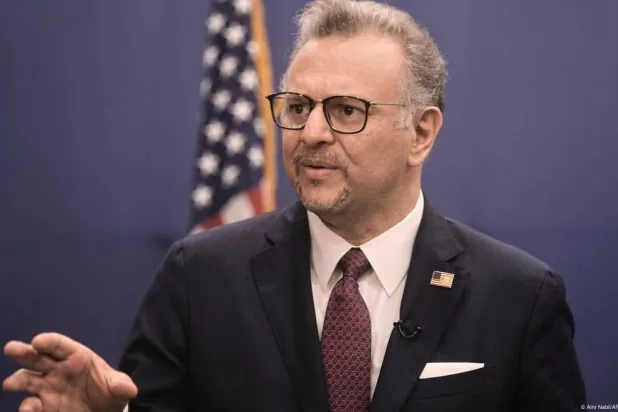
Massad Boulos, senior advisor to US President Donald Trump for Arab and African affairs, said diplomatic efforts led by Washington to unify Libyan institutions and reach a political settlement to the crisis have achieved “tangible: progress, stressing his country's support for a Libyan-led political track culminating in unified governance and credible elections. In remarks to Asharq Al-Awsat, Boulos reiterated that the US is seeking to establish a unified Libyan executive authority capable of administering all Libyan territory, providing security and economic stability for the population, and paving a credible path toward holding successful national elections. US efforts have succeeded in narrowing many gaps of disagreement between the Libyan parties over more than a year, he added, without providing details on the nature of the understandings reached or whether they are tied to a timeline for forming a unified executive authority. Boulos’s remarks come amid renewed diplomatic activity on the Libyan crisis, as political and institutional division persists between the east- and west-based governments, military and security centers of influence remain fragmented, and efforts to organize national elections to end the transitional phase continue to falter. In recent months, media reports have circulated details of a US initiative to unify authority in Libya, under which Saddam Haftar, deputy commander of the Libyan National Army (LNA), would assume the presidency of the Presidential Council, while Government of National Unity (GNU) Prime Minister Abdul Hamid al-Dbeibah would head a unified government. Boulos did not disclose details regarding this formula in his remarks. He stressed that the work of the United Nations Support Mission in Libya complements the US initiative and efforts aimed at enabling the country to reach a unified executive authority capable of extending state sovereignty. He signaled continued coordination between Washington and the UN on the political track. However, Boulos’s remarks did not include a direct stance on the recent naval attacks targeting the port of Benghazi, or on their potential repercussions for Libya's security and sovereignty, amid fears that the fallout of the Russia-Ukraine war could spill over into Libya, and concerns over the country being drawn into international and regional conflicts. He also did not clarify Washington's position on the demand by the parliament-designated government for an international investigation into the attacks, or on the UN mission's call to open an immediate, independent inquiry to uncover the circumstances and determine responsibility. Amid ongoing Libyan division, the attacks raise questions about the ability of security and military institutions to handle external threats, as well as the extent to which international developments affect the country's sovereign interests at a time when US efforts are focused on unifying political, economic, and security institutions. On Monday, the US State Department renewed its call for forming a unified Libyan government and holding credible elections, affirming that Washington supports the establishment of an executive authority capable of extending its control over all Libyan territory.