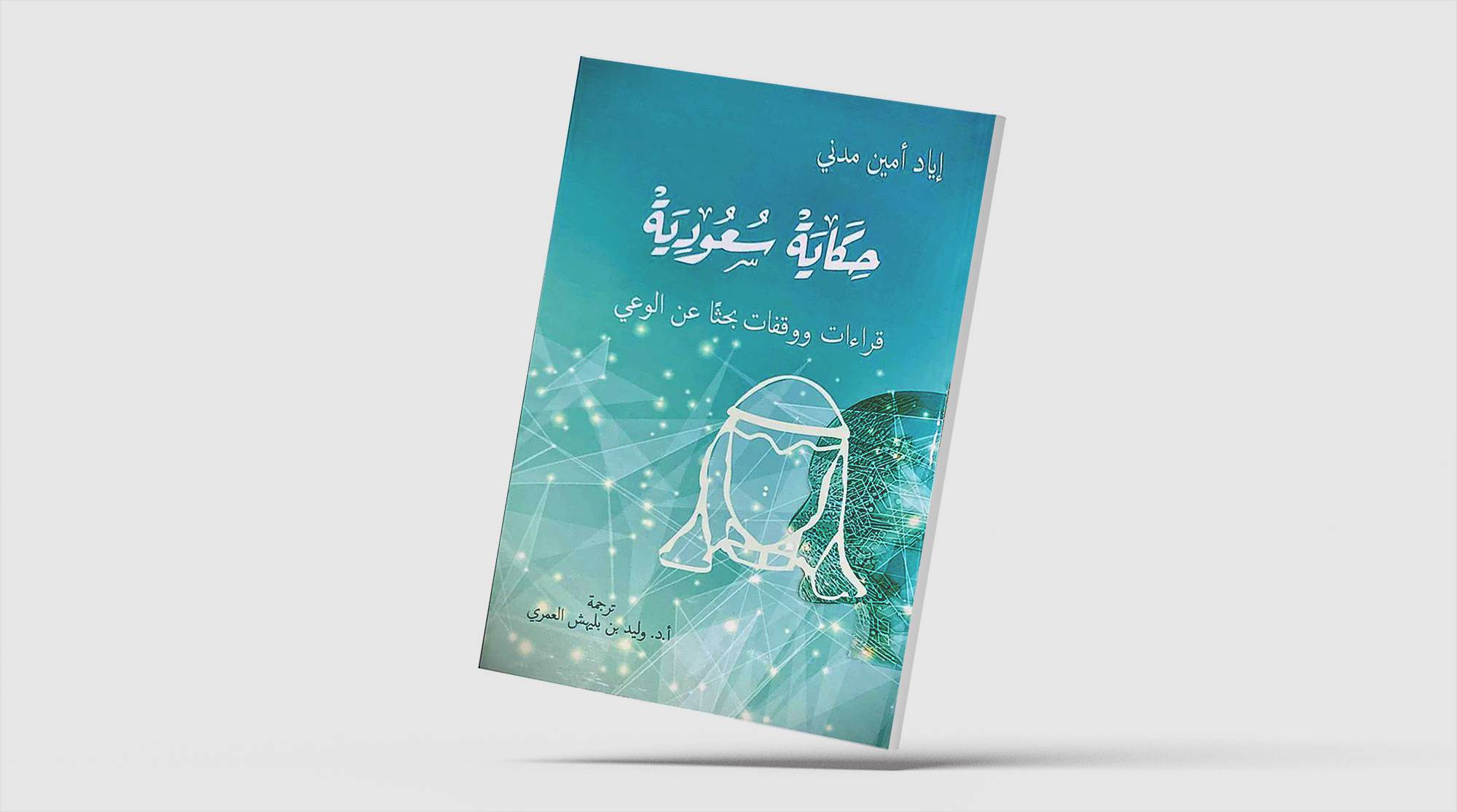
RIYADH: In his book “A Saudi Tale: Readings and Encounters in Search for Consciousness,” Iyad Ameen Madani, a Saudi journalist and former minister, is less concerned with recounting the milestones of his life than exploring how his consciousness was shaped and seeking the meaning of his Saudi, Arab and Islamic belonging in a world torn between identities, ideas and centers of power.
It is an intellectual biography that uses personal experience as an entry point for interrogating social, political and cultural transformations, and individual memory as a means of understanding the questions of a Saudi generation that lived through major changes in its country and the world.
The book, first published in English as “A Saudi Tale: Readings and Encounters in Search for Consciousness” and translated into Arabic by Dr. Waleed Bleyhesh Al-Amri, represents an extension of its author’s career spanning journalism and public service.
He served as editor-in-chief of Saudi Gazette, director-general of the Okaz Foundation, then as a member of the Shoura Council, and as minister of Hajj and of culture and information, culminating in his role as secretary-general of the Organization of Islamic Cooperation.
These positions, however, do not form the book’s focus but rather the backdrop that enabled its author to test his ideas about society, the state and the world.
From biography to the question of consciousness
Madani begins with the concept of consciousness, which he does not reduce to knowledge or intellectual positions, but sees as a comprehensive formation that defines a person’s relationship with himself and his surroundings.
In his introduction, he says: “It is said that consciousness is not merely opinions, information or a system of values, but a comprehensive state, an integrated formation that shapes our perception of reality and grants us a holistic vision of the world.” He then says: “These pages are essentially a dialogue with the self, about what it means to be Saudi, and also Arab and Muslim.”
From this starting point, he poses the question that governs his project: “Can these identities be reconciled with the givens of modernity? What is modernity, really? Can there be multiple modernities? Indeed, has modernity itself become an outdated concept?”
The author does not claim to possess final answers, but describes his work as “a reflective journey through an intellectual biography, tracing the sources and courses of consciousness.”
The book is divided into five sections, beginning with Components and Frameworks, in which he addresses the formation of consciousness, his journalistic experience and the emergence of the new world order. The second section, An Ideal Societal System, discusses issues of the general will, the individual and social relations.
He then moves to The Global South, in the Footsteps of Authenticity, to questions of liberation, discrimination and identity, before examining in Close Horizons the Islamic worldview, the Arab predicament and the Saudi narrative, culminating in the section The Outcome.
Among the book’s most telling passages is the author’s recollection of the atmosphere of Madinah in his youth, when intellectual and political discussions flourished among school students during the 1960s and early 1970s. He notes that such debates were neither frowned upon nor rare, but were “part of everyday intellectual activity.”
Here he recalls names such as Mohammed Hassan Awwad, Abdullah Al-Qasemi, Ahmed Al-Sibai, Hamza Shehata and Abdullah Abduljabbar as figures of that intellectual ferment. He pauses on Awwad’s book “Khawatir Musarraha” (“Outspoken Reflections”), which he sees as having helped break the stagnation and open the way for modernity. He also reflected on the intellectual transformations of Abdullah Al-Qasemi, who moved from defending tradition to critiquing inherited norms and calling for liberation from the authority of history and rigid doctrines.
The young people’s interests did not stop at Arab thought. Existentialism was present through Jean-Paul Sartre, Albert Camus and Simone de Beauvoir, alongside Fyodor Dostoevsky, Arthur Miller and Emily Bronte, as were the causes of nationalism, liberation from colonialism and scientific socialism, and the ideas of Mohammed Iqbal, Ali Shariati, Jamal Al-Din Al-Afghani, Mohammed Abdo and Malek Bennabi.
The author evokes a scene from cultural life in Madinah, when Umm Kulthum’s voice reached gatherings of young people under the palm trees via Egyptian radio, in a scene where music intertwined with reading and discussion.
Madani does not exaggerate the maturity of that experience, acknowledging that the discussions were not always profound, but came within “persistent attempts to create an inner sense of understanding the self, and at the same time of belonging to a wider world in which ideas and identities intersect and questions intertwine.”
This testimony offers a glimpse into the history of Saudi culture, revealing that questions of freedom, modernity and identity were present among young people decades ago.
Saudi identity occupies a central place in the book. Madani rejects reducing Saudis to their Arab or Islamic identity alone, calling for an understanding of the specificity of their historical and cultural experience, “not as Saudis being merely Muslims or Arabs, but as Saudis with their own unique identity and particular experience.”
He notes that Saudis were not subjected to Western colonialism, yet were not isolated from its cultural and intellectual influences. He therefore does not believe that confronting stereotypes is achieved through rejection, but through acquiring knowledge and the tools of research and development, and the ability to produce an independent vision of progress.