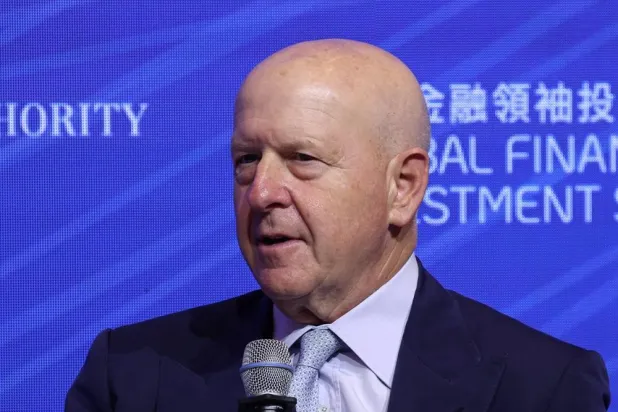
Tech companies will need to raise more capital to help meet the enormous demand for the AI industry's growth boom, but there is a risk of an industry correction, global financial leaders said on Tuesday. Tech stocks globally have faced pressure in recent weeks as growing concerns about AI spending trigger a new wave of selloffs, with combined spending set to exceed $730 billion this year, up from about $700 billion. Most of the major tech companies were expected to raise more capital to keep up with the enormous likely demand from the AI industry's growth, said Jon Gray, president of Blackstone, which is an active investor in AI infrastructure. "Now you're in an environment where the demand's running well ahead of supply," Gray said at an investment gathering in Hong Kong, citing "pretty extraordinary" demand for computing power. "So that gives me a lot of comfort," he added. "Meta and Google and Oracle raising equity ... SpaceX going public, Anthropic going public," Gray said. "On top of it ... the data centers, the energy needs are enormous." STRONG COMPANIES WITH 'GOOD STORIES' Despite some AI-related market upheavals, strong companies with "good stories" would still be able to raise capital, though the industry's strong growth could create volatility for investors, said Goldman Sachs Chief Executive David Solomon. "But things will go wrong too, and we'll get things wrong," he added at the event, the Hong Kong Monetary Authority's Global Financial Leaders' Investment Summit. "Investors will find situations where they pick wrong, where they lose money ... It's important to have a balanced, diversified view." JPMorgan Vice Chairman Daniel Pinto said he was bullish on AI, but the market was pricing in revenue and earnings growth for related companies that was too steep. "I do believe that it has a positive, slow curve and it may not be as steep as the market is pricing," he said. "So I think that it could be a correction in the AI sector," he said, adding that other firms with high valuations related to AI could come under pressure as the industry started to recalibrate its expectations. Last month, S&P said it expected the top six US hyperscalers - Amazon, Microsoft, Alphabet, Oracle, Meta and SpaceX - to spend more than $7 trillion on data centers and other AI-related capex between 2025 and 2030, while having negative free cash flow until at least next year. Citadel Securities Chief Executive Peng Zhao said the sheer scale of capital and growth in AI was proving difficult for some investors to value correctly, which was adding to volatility in the sector. "Our ability to really know what this technology will do and its revenue potential is very, very limited due to the fact that we've never seen anything like this," he said. "It's not so much that people all of a sudden develop a bearish view of what the technology can accomplish, but it's rather the sudden realization that we can only know so much ... the numbers involved are so huge." Morgan Stanley Chief Executive Ted Pick flagged emerging early signs of US markets edging close to a correction, with a majority of stocks in major indices off nearly 10%. The latest test of investor appetite is a sale of €6 billion ($6.7 billion) in bonds on Monday by Google parent Alphabet . ASIA-PAC TECH FUNDRAISING MORE THAN TRIPLED Fundraising by Asia-Pacific tech companies more than tripled to $125.8 billion in the first three quarters of 2026 from $36 billion a year earlier. The growth was driven by a wave of semiconductor and AI-related deals, such as Chinese chipmaker CXMT’s $9.8-billion IPO and Enflame Technology's $910.6-million listing, LSEG data shows. Alphabet, Amazon, Microsoft and Meta have signaled that spending on AI will not slow. In one of the largest debt deals tied to the AI buildout, Blackstone agreed last week to provide financing of $63 billion with Bank of America, Citi and Morgan Stanley to buy Broadcom's AI chips and networking gear for Anthropic. The rising cost of capital and some of today's skepticism will slow the pace, however, Gray added. "But the overall trend is towards greater investment and therefore more needs for multiple forms of capital." Emmanuel Roman, CEO of asset manager PIMCO, said AI financing deals are attractive, with more coming for the firm.