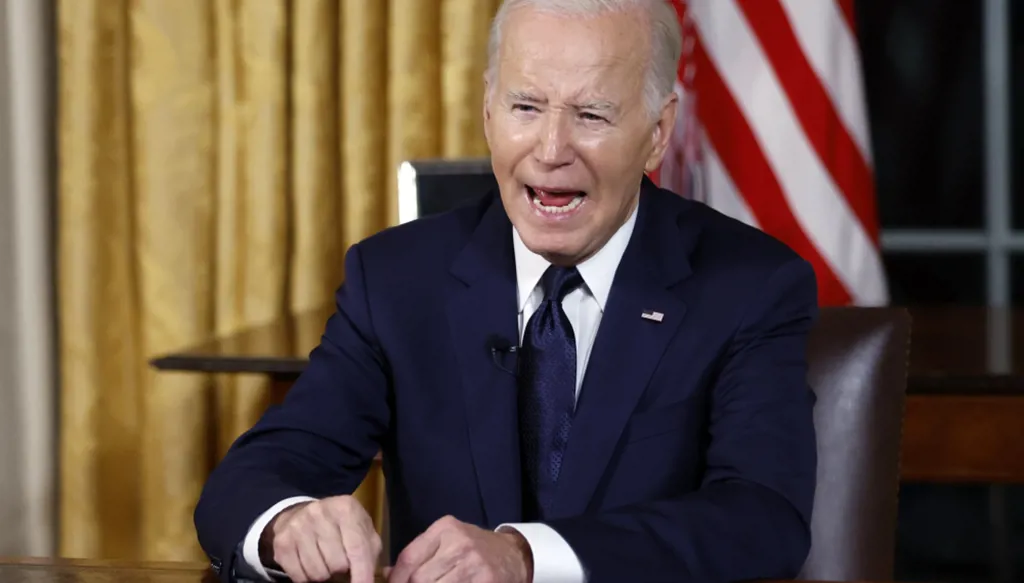
The American media continues to spotlight the new book by former U.S. President Joe Biden.
Titled Promise Me, America, the book will be officially released on November 17. It offers Biden's presidential memoirs, reflecting on key political events during his term, from 2021 to January 2025.
Here are the main issues addressed in the book, particularly in foreign policy, according to a report by The Wall Street Journal.
Biden opens his book with a scathing assessment of the riots that took place at the U.S. Capitol on January 6, 2021.
Writing about his predecessor, Donald Trump, Biden says: "The President of America was not leading America, but leading an insurrection. It was one of the worst breaches of presidential duty in our history."
However, Biden notes that upon arriving at the Oval Office following his inauguration, he found a gracious note from Trump, despite the latter's months-long attacks during the election campaign.
Biden writes: "It was almost as if there were two versions of (President) Donald Trump."
Biden expresses no regret over the U.S. withdrawal from Afghanistan, saying: "I would make the same decision again. Ending the war in Afghanistan was the right decision."
The former president says he faced resistance from within his own administration.
He explains that he had received assurances that the Afghan government would be self-reliant and that Kabul would withstand the aftermath of the U.S. forces' departure for at least six months.
However, he adds: "The six-month timeline I was promised evaporated within days. This deeply impacted the orderly nature of the withdrawal."
Biden describes Russian President Vladimir Putin as cheeky, writing that he "enjoyed slouching during meetings, feigning indifference, like a teenager."
While Biden believed Ukrainian President Volodymyr Zelensky's acting background "proved to be very good training" for leading his country during wartime, he notes that Zelensky was "moody and stubborn in our private conversations and did not show the level of gratitude I had expected."
Biden also writes that members of Trump's team asked him to sign a letter allowing them to negotiate directly with Putin before Trump could return to power. However, Biden refused, saying he was not "ready to give them a carte blanche for what I expected to be a kind of surrender at Ukraine's expense."
In a chapter addressing the October 7, 2023, attacks in Israel, Biden accuses Israeli Prime Minister Benjamin Netanyahu of prioritizing his short-term political survival over Israel's long-term needs.
Biden writes: "There wasn't much trust between us. I was also worried about Bibi (Benjamin) having traits similar to Trump. He could be casual with the truth and saw no issue with bending and reshaping democratic institutions to suit his personal interests."
Biden adds that he would "never regret standing by Israel following the attacks of October 7. It was the worst attack against the Jewish people since the Holocaust."
However, he also writes: "Too many innocent Palestinians were killed. Much pain was inflicted on people who had nothing to do with (the group) Hamas ... I carry that pain within me."
Biden writes that when he gathered his top advisors in spring 2023 to discuss whether he should run for a second presidential term, no one objected.
"Everyone was in favor," he writes, adding that he considered running a "duty."
Biden says his decades-long political experience "outweighed the obvious weaknesses associated with my advancing age, including a weaker voice, increased tendency to mix up names and places, and slower steps."
He adds that he did not believe any potential Democratic candidates were "stronger candidates than me, or had a better chance of winning the 2024 election. You may reject this assessment if you like, but I know the path I took to reach this conclusion. I made a reasoned, precise, and firm judgment."
Biden addresses Special Counsel Robert Hur's 2024 report on his handling of classified documents. Hur described Biden as a "well-meaning old man with a weak memory."
Biden writes: "If Trump's campaign had written the report itself, it couldn’t have invented a better phrase to inflict as much political damage as possible."
He adds that he was intensely angered by Hur's suggestion that he did not know the date of his late son Beau's death.
"That still hurts me as much today as it did on May 30, 2015. So if Robert Hur wants to know when my son died, here’s my answer: today. I wake up every day feeling like I lost him just a minute ago."
Reflecting on his stumbling performance during the presidential debate, Biden writes that it came after a series of intense trips. He says he felt "in such a bad condition that I took a test for COVID, and it came back negative."
This coincided with the repercussions of his son Hunter Biden being indicted on three criminal charges. Biden writes: "This broke my heart."
Biden recalls arriving at the debate venue in Atlanta, saying: "It didn’t feel like things were going well from the start."
He adds that at a crucial moment, "I lost my train of thought."
When Biden said, "We finally overcame the Medicare program," he meant to say, "We finally overcame the big pharmaceutical companies."
Biden acknowledges that he realized his debate performance had been poor, but assumed he would have another chance. However, he admits: "I was wrong."
Biden describes private meetings with House Speaker Nancy Pelosi and Senate Minority Leader Chuck Schumer in the aftermath of the debate.
He writes that Pelosi was "actively working behind the scenes to push elected officials and pro-Biden delegates to defect," while warning him that polling indicated he could not win.
As for Schumer, he traveled to Biden's home in Delaware to urge him to withdraw from the race.
Biden writes: "I told Schumer he had some boldness (and perhaps I used a different expression at the time), coming to my home to ask me to leave the race. Loyalty matters to me."
Later, Biden met Pelosi at an Italian restaurant. He writes that he did not bring up her efforts to push him out of the race.
"We had been through too much together to allow a rift in our relationship without mending it. So we talked about life, family, and politics, and gradually returned to our old friendship rhythm."
He sums up the encounter by saying: "I'm glad we did that."