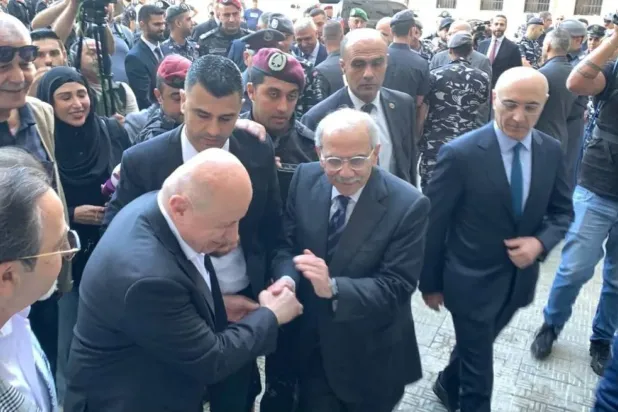
Lebanese Parliament Speaker Nabih Berri has moved to rein in political attacks by his ally Hezbollah against Prime Minister Nawaf Salam, with sources close to Berri telling Asharq Al-Awsat that he pushed for a de-escalation between Salam and a large segment of residents in southern Lebanon. The shift was reflected in Salam’s visit to Nabatieh on Friday and reinforced in a Sunday interview on NBN, a channel affiliated with Berri’s Amal Movement. Salam reiterated the government’s position on Israel’s withdrawal from southern Lebanon and its commitment to restoring the state’s role and activating its institutions there. Salam’s meetings Monday offered further signs of a drive to strengthen the state’s presence in the south. He met Berri to discuss political and field developments, pressing social and economic conditions, the outcome of his US visits and his Nabatieh tour and projects launched there, the speaker’s office said. At the Grand Serail, Salam met Head of Council for the South Hashem Haidar, who briefed him on the council’s work and projects announced during the Nabatieh visit and steps taken to begin them. Positive signs Friday’s trip was Salam’s third visit to the south in three months. It was notably coordinated, with Amal MP Hani Qobeissi welcoming him alongside Finance Minister Yassin Jaber, himself from Nabatieh, and Interior Minister Ahmad al-Hajjar. Municipal leaders from Nabatieh-area villages aligned with Hezbollah also joined the reception. Although Hezbollah’s political representatives were absent, the group issued no statement criticizing the visit or Salam, unlike on previous occasions — a sign of the de-escalation promoted by Berri. Sources following the visit noted that the tour and meetings “repaired a large part of the relationship between Salam and the people of the region.” They said Hezbollah MP Mohammad Raad, the party’s representative in Nabatieh, was absent because he does not attend social occasions for security reasons. Hezbollah-aligned municipalities took part, while opposition to the visit appeared marginal. In another sign of de-escalation, Hezbollah MP Hassan Fadlallah said Monday the group supported strengthening the state’s role in the south and having it assume full responsibility, “but that begins with expelling the occupation, stopping the aggression and ending this bulldozing operations and destruction in our villages.” He urged the state to match words with actions, backed development initiatives in the south and called for the disbursement of a $250 million World Bank loan, part of which is allocated to the region, as well as increased government spending there in the 2027 budget. Berri consistent with his demands Unlike Hezbollah, which has attacked Salam in recent months, communication between the prime minister and Berri has continued. Berri has pressed for activating state institutions in the south, securing stability and the ceasefire, enabling residents to return to their villages and providing services to bolster their steadfastness, despite opposing direct negotiations with Israel and having earlier declared the “framework agreement” defunct. Amal sources told Asharq Al-Awsat that Berri was consistent with his demand for state institutions to be present in the south. Salam’s visit, they said, confirmed the executive authority’s intention to strengthen that presence, making it natural for Amal and its Development and Liberation bloc to “meet it halfway.” The sources underlined that the visit “soothed the wounds of southerners” and opened the door to a stronger state presence. They also pointed to Salam’s acknowledgment that resources were limited and reconstruction required international support because Lebanon could not undertake it alone. ‘No punishment of any community’ In Sunday’s NBN interview, Salam said: “The state cannot remain in a state of waiting. We must go to the south and to all regions and assume our responsibilities.” He reiterated the need to stop Israeli attacks, consolidate the ceasefire, secure Israel’s withdrawal from occupied Lebanese territory and work for the release of prisoners. “When I return for a fourth time to Nabatieh and Tyre, I want to see with my own eyes that water and electricity have been restored, that the contracts we launched are actually being implemented, that schools are being repaired, and that our people are returning and feel safe,” Salam added. “If I wanted to punish a particular community, I would not personally be following these operations and the response to demands every day.” Salam stressed that dialogue with all sides remained open, adding that agreed measures now had to be implemented and each side must honor its commitments. Addressing residents of the south, he said: “You are not alone. The state is with you, beside you and at your service,” citing the presence of security agencies, institutions and services in Nabatieh.