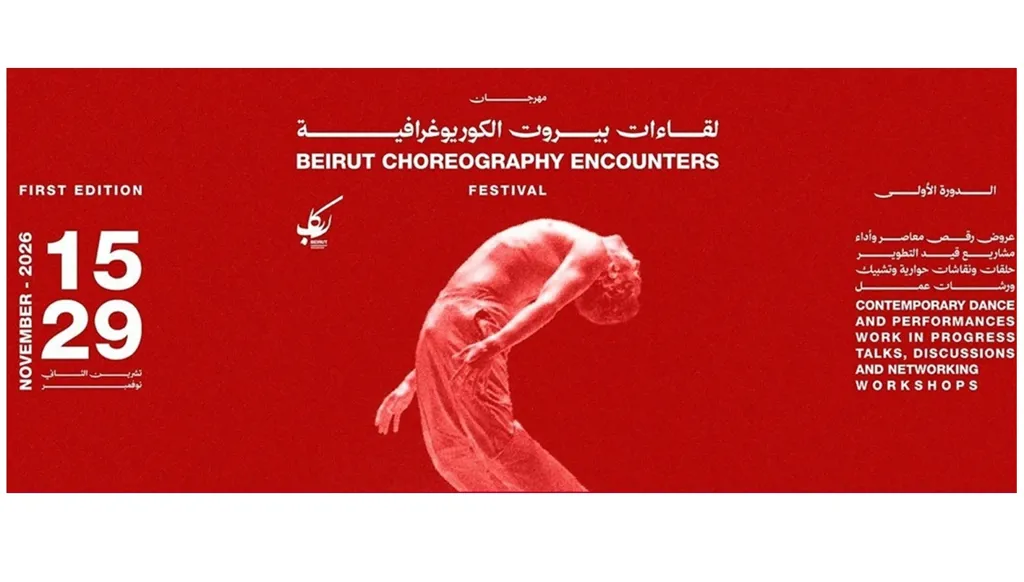
The first edition of the 'Beirut Choreography Encounters' festival begins today, Sunday, November 15, 2026, featuring more than 30 artists from Lebanon, the Arab region, and around the world. The event runs until November 29 and includes contemporary dance performances, workshops, and artistic meetings across several cultural spaces in the capital.
Starting today, Beirut hosts the first edition of the 'Beirut Choreography Encounters' festival, organized by 'Beirut Physical Lab' under the slogan 'Body Is Not Alone'. The initiative aims to strengthen the presence of contemporary dance in Lebanon's cultural scene and open new spaces for cooperation and exchange among artists.
The festival brings together dancers, choreographers, directors, and performing arts practitioners from Lebanon, the Arab world, and abroad through a program held at 'Theatre de la Ville', Sursock Museum, 'Beit Beirut', the French Cultural Center in Lebanon, and Union Marks, alongside Amalgam Studio and Koon Studio.
Performances begin tomorrow, Monday, November 16, with the choreographic work 'LABES' by Tunisian artist Selim Ben Safia at 'Theatre de la Ville'. The show brings together four dancers and a musician in an experience exploring the relationship between rigidity and resilience, with scenography by artist Nadia Kaabi Linke that invokes the memory of the Moroccan Quarter in Jerusalem.
On November 17, the French Cultural Center in Lebanon will host 'Un peu du souffle de ma mère' by artist Mohamed Issaoui, as part of a program featuring various dance and movement performance experiences.
On November 25, a series of performances will also take place at 'Theatre de la Ville', including 'Descending from Below' by Sara Menhem and 'To Dance Is All I Can Do To Console You' by Omar Al Bakeer, Rima Maroun, and Marielise Aad, in addition to a work by Yohanna Naji Daher.
Among the notable performances is 'The Dance of Enkidu on the Collapsing Mountain' by artist Bassam Abu Diab, which reinterprets the Epic of Gilgamesh through contemporary dance, debke, and zajal. The work combines movement, music, and memory while addressing concepts of heroism, loss, and conflict.
The performances continue until November 29, with the participation of other artists, including Hoor Malas, Ahlam El Morsli, Pamela Hayek, and Dominique Tegho, in works addressing various human themes and experiences through the body and movement.
In addition to the performances, the festival dedicates space to training workshops and professional meetings, beginning today with a workshop led by artist Romane Piffaut at Koon Studio. The program will continue over the next two weeks, with the participation of artists from Lebanon and abroad.
The workshops include contemporary dance, dabke, and traditional Tunisian dance, alongside experiences combining movement with music and sound, aiming to provide opportunities for training and exchange between artists and participants.
The program also includes a panel discussion titled 'The Art Scene After the War' on November 26, moderated by Nora Mourad at the French Cultural Center in Lebanon, accompanied by the screening of the dance film 'Unwanted Lullaby' by the group 'Leish'.
On November 28, 'Beit Beirut' will host meetings discussing 'The Arab Dance Platform', the realities of performing arts, and ways to develop cooperation between artists and cultural institutions. The festival dedicates its final day to presenting new artistic projects and providing a platform for artists, troupes, and institutions to introduce their work and explore opportunities for collaboration.
The first edition is coordinated with the 'Arab Dance Platform' (ADP), which brings together three independent contemporary dance festivals in Beirut, Tunis, and Casablanca within an initiative aimed at strengthening artistic exchange and creating ongoing opportunities for collaboration among creators in the Arab region.
The project is supported by the Arab Fund for Arts and Culture 'AFAC', in partnership with 'Oxfam', 'Eco Electric', and 'Megaphone', with co-funding from the European Union, in addition to support from the 'Halaqat' program of the Goethe-Institut and the British Council.
The slogan 'The Body Is Not Alone' reflects the festival's vision of performing arts as a space for solidarity and collaboration, rather than merely performances presented to an audience. With the launch of this edition, Beirut adds a new date to its cultural calendar, giving contemporary dance a broader presence in a city that continues to find in art a means of expressing itself and the stories of its people.