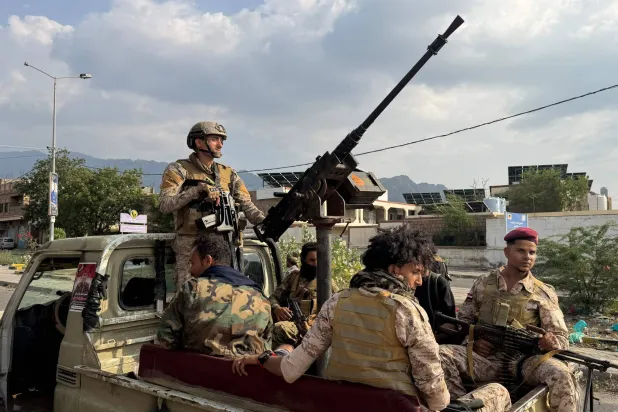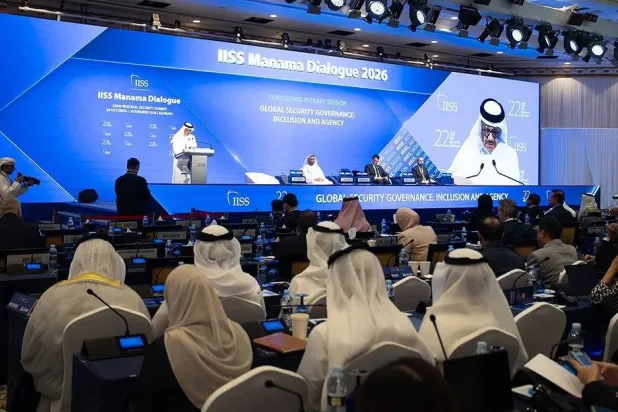
Bahrain on Sunday called for the establishment of a regional security framework based on respect for sovereignty, freedom of navigation and the rejection of force, saying it would remain open to Iran if Tehran adhered to those principles. Meanwhile, the United Arab Emirates expressed hope for a diplomatic breakthrough that would prevent renewed military confrontation in the region, while stressing its readiness for the worst-case scenario. The two positions were outlined during the concluding session of the Manama Dialogue 2026, as diplomatic efforts continued to contain tensions between the United States and Iran amid warnings about the consequences of another confrontation for Gulf security, maritime routes and the global economy. Bahraini Foreign Minister Abdullatif bin Rashid Al Zayani, speaking during a session titled "Global Security Governance: Inclusion and Agency," said regional developments this year had exposed the scale of the security challenges facing Gulf Cooperation Council (GCC) countries and Jordan. He said the countries had endured nearly 7,000 attacks involving ballistic missiles, drones and cruise missiles targeting civilian and economic infrastructure, including airports, ports and data centers. Al Zayani stressed that Gulf security "must be shaped by the countries of the region themselves through partnerships based on respect for sovereignty and non-interference in internal affairs." He emphasized Bahrain's appreciation for every initiative that contributes to reducing tensions and opening the way for dialogue. He called for an interconnected and cooperative regional security framework open to all neighboring countries willing to respect sovereignty and freedom of navigation and renounce the threat or use of force. "The door remains open to Iran, as it does to others, but it leads to rules, not exceptions, and to actions, not intentions," he said. Strait of Hormuz and Maritime Security Addressing maritime security, the Bahraini foreign minister revealed that approximately 1,600 vessels had been held up in the Strait of Hormuz since the crisis began, while more than 23,000 seafarers had been deprived of freedom of movement. "Hundreds of vessels and thousands of seafarers remain stranded," he said, noting the repercussions for energy markets, international trade, and food and medical supplies. He warned that disruptions to shipping threatened the food security of as many as 45 million people, most of them in countries of the Global South. "No state has the right to subject passage through an international strait to its permission or use it as a means of political and economic pressure," he stressed. Al Zayani referred to UN Security Council Resolution 2817, submitted by Bahrain on behalf of GCC countries and Jordan and supported by 136 countries, saying the broad backing reflected growing international concern over threats to maritime routes. However, he argued that "the problem lies not in the absence of legal rules, but in the weakness of their enforcement." He called for a collective framework to protect maritime and air navigation based on international law, while enabling the UN General Assembly to act when the Security Council is unable to take the necessary measures. He also proposed agreeing on international principles prohibiting the use of waterways and submarine cables as instruments of pressure or threats, with the principles to be adopted by the UN General Assembly. Warning Over Threats to Digital Infrastructure Al Zayani accused Iran of continuing to target airports and civilian facilities in several regional countries, even after understandings that were supposed to curb the escalation. He also cited attacks carried out by armed groups linked to Tehran from Iraqi territory against Gulf countries and Jordan. The foreign minister condemned the escalation of Houthi attacks against Saudi Arabia, including strikes targeting airports in Riyadh, Abha, Jazan, Najran and Dammam, as well as energy facilities, reaffirming Bahrain's full solidarity with the Kingdom. He referred to the UN Security Council's condemnation on October 15 of the escalating Houthi attacks against Saudi Arabia, its reaffirmation of the Kingdom's right to self-defense, and its call to prevent weapons from reaching the Houthis. Al Zayani also warned that threats were expanding to digital infrastructure, citing threats by Iran's Revolutionary Guard Corps to target submarine cables crossing the Strait of Hormuz, as well as threats against data centers and artificial intelligence facilities. He said regional security was now tied to three critical domains: maritime navigation, aviation and data flows. He called for the development of international rules to protect these domains and for a treaty governing artificial intelligence, in line with an initiative proposed by Bahrain's Crown Prince and Prime Minister Prince Salman bin Hamad Al Khalifa. Al Zayani affirmed that Bahrain would continue working through the UN Security Council and its regional and international partnerships to strengthen security and stability. He stressed that "the effectiveness of the international system requires the implementation of its resolutions without selectivity," including resolutions concerning the Palestinian people's right to establish an independent state. Gargash: Braced for the Worst For his part, Anwar Gargash, Diplomatic Adviser to the UAE President, expressed hope that ongoing diplomatic efforts would succeed in containing the confrontation between the United States and Iran, warning against the risks of another round of war. "We're hoping that there is a diplomatic breakthrough," Gargash said during the session. "It is not the interest of the region to go through another round... But I think we're also, as we've shown before, braced for the worst," he added. His remarks came as Qatar held consultations with Iran and the United States in an effort to reach an understanding that would end the escalation, amid continuing disagreements over Iran's nuclear program, restrictions on navigation through the Strait of Hormuz and the US blockade of Iranian ports. US President Donald Trump had renewed threats of further military strikes against Iran on Saturday, while Secretary of State Marco Rubio affirmed that Washington remained open to diplomatic solutions and that no decision had yet been made on launching new attacks. Gargash stressed the importance of strengthening "regional partnerships" and "economic integration" as ways to overcome differences. He called for "respecting state sovereignty and ending the role of militias that undermine security and stability." He emphasized that the region must not become an arena for settling international conflicts, underscoring "the importance of adopting an approach based on dialogue and cooperation and moving away from extremist rhetoric that obstructs opportunities for peace." Gargash also called for intensified efforts to reach a settlement of the Palestinian issue leading to the establishment of an independent state. He reaffirmed the UAE's commitment to working with its regional and international partners to support security, stability and development in the Middle East.