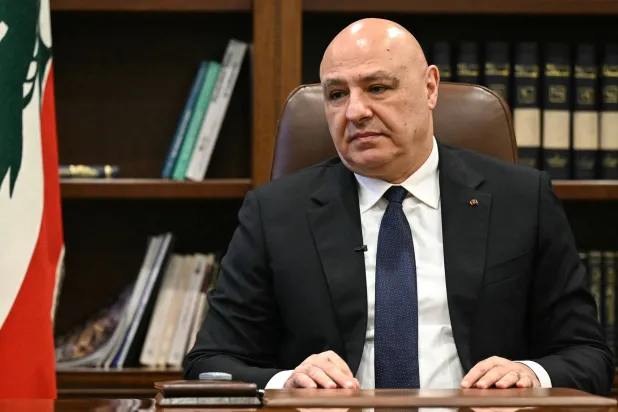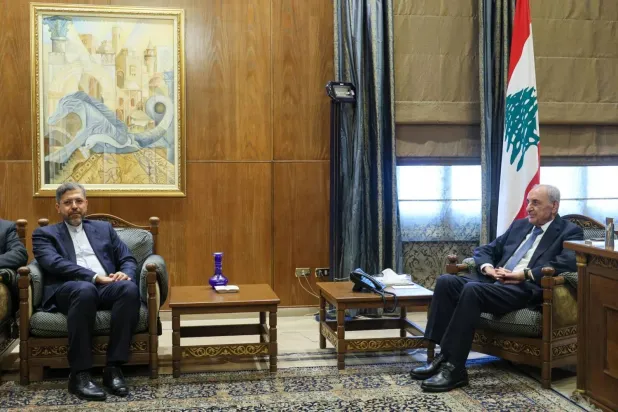
Iranian Foreign Minister Abbas Araghchi’s call with Lebanese President Joseph Aoun coincided with the arrival in Beirut of his aide, Saeed Khatibzadeh, as Tehran moved to reassert its presence in Lebanon after a prolonged absence. Well-informed Lebanese sources said the Iranian push came amid differences with Aoun and Prime Minister Nawaf Salam over their approach to Lebanon, while Tehran also sought to contain tensions caused by the withdrawal of Mohammad Reza Sheibani’s credentials as Iran’s ambassador to Lebanon. Araghchi and Aoun agreed on the need to support diplomatic solutions as the best way to end conflicts in the region, according to the Lebanese presidency. The sources told Asharq Al-Awsat that Araghchi told Aoun Iran remained committed to the Iranian-American “memorandum of understanding” and to implementing all its provisions, including one calling for an end to wars on all fronts, Lebanon among them. He blamed the United States for the failure to implement the agreement, accusing Washington of imposing “impossible conditions whenever we come close to implementing it” and saying mediators had continued trying to persuade it to return to negotiations rather than threaten renewed war. Political message The sources said Araghchi’s call was intended to send a political message that Tehran remained present in the Lebanese file and that “the tension caused by the withdrawal of Ambassador Sheibani’s credentials is now behind us.” They said the issue no longer blocked renewed contact with Aoun, who, along with most Lebanese political forces, remains committed to the “framework agreement” and has no intention of replacing it with the Iranian-American “memorandum of understanding.” Hezbollah’s opponents, meanwhile, viewed Khatibzadeh’s Beirut visit as primarily Shi’ite-focused and aimed at assessing the concerns of the “Shiite duo,” Hezbollah and the Amal Movement. The sources said that explained his meetings with Parliament Speaker Nabih Berri and Hezbollah’s leadership. The contrast in tone was clear. Diplomacy dominated Araghchi’s call with Aoun. Khatibzadeh, by contrast, spoke in much harsher terms. He was quoted as telling journalists that “negotiations are pointless, and we are preparing for the worst-case scenarios,” and that direct talks between Lebanon and Israel would lead nowhere because Israel was “an occupying entity.” He said Israel wanted to use negotiations as a first step toward expanding its dominance across the region and ultimately achieving what is known as “Greater Israel.” “As long as the Israeli occupation remains in southern Lebanon, the resistance will remain, weapons will continue to be necessary, and anyone who cares about Lebanon’s interests should support this approach,” he was quoted as saying. Asked about ties between Iran and Hezbollah, Khatibzadeh said the relationship was “not hierarchical, from the top down,” and that Iran did not interfere in Lebanese affairs, which were “left to the Lebanese themselves.” He also claimed that “Hezbollah does not ask us what it should do, but it sometimes asks us how it can be more steadfast and tougher in confronting the enemy, while avoiding asking us about Lebanon’s internal affairs.” Iran-US negotiations Khatibzadeh also addressed Iranian-American negotiations, saying there was little prospect of an agreement. “The chances of reaching an agreement are, so far, nonexistent, as shown by previous experience when Washington launched a war against us while negotiations were still underway,” he was quoted as telling journalists. He also pointed to differences within the United States, saying one camp did not want to implement the provisions of the “memorandum of understanding,” while another had sought an agreement. “The administration of US President Donald Trump is suffering from internal fragmentation. Otherwise, had it honored its commitments, we would have reached an agreement,” Khatibzadeh said. He added that the United States’ power had been broken and would be broken again. Asked about the direction of events in the region, he said “Political realism requires us to say that, until further notice, we have the right to prepare for the worst-case scenarios in the face of American threats.” Iran’s relations with Syria On Syria, Khatibzadeh said Iran was “in no hurry.” “We are ready to communicate with Syria when it decides to do so. It is currently going through a sensitive and dangerous phase, and Türkiye committed a strategic mistake and contributed to the Israeli-American ‘puzzle,’ one result of which was that Syria handed Israel a gift,” he said. The sources said, therefore, that Khatibzadeh’s meetings in Beirut reflected no change in Iran’s position. His remarks, they said, were meant to stress Tehran’s adherence to its existing stance, which largely aligns with Hezbollah Secretary-General Naim Qassem’s rejection of the “framework agreement.” The sources asked whether Khatibzadeh had carried a message aimed largely at stirring opposition to the “framework agreement,” without naming it directly, in contrast with Araghchi’s emphasis to Aoun on diplomatic solutions. Araghchi’s diplomacy was thus met by a much harder line from his aide, raising the question of whether Khatibzadeh was conveying a message closer in substance to the position of Iran’s Revolutionary Guards than to that of the political camp Araghchi represents within the Iranian establishment. Otherwise, the sources said, he would not have needed to make statements amounting to interference in Lebanese affairs, the kind of positions that have fueled the tensions still weighing on Lebanese-Iranian relations. Those positions have been firmly rejected by a majority of Lebanese who support the “framework agreement” and back Aoun’s diplomatic approach after Hezbollah pursued the military option, leaving the country with incalculable human and material costs.