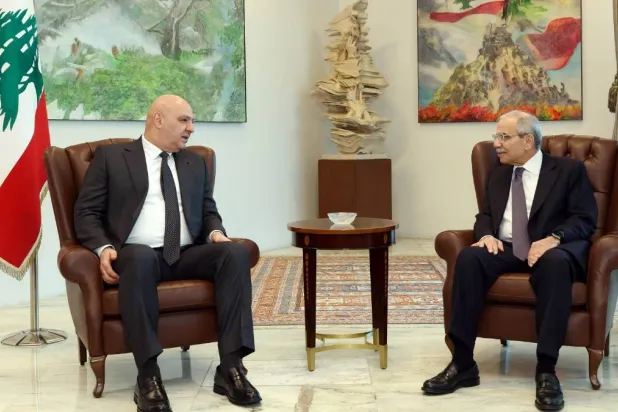
Lebanese President Joseph Aoun defended on Tuesday the option of direct negotiations with Israel, stressing that resorting to diplomacy is neither surrender nor defeat, but rather a means of achieving Lebanon’s objectives and restoring its rights. He stated that “diplomacy is not surrender; it is one of the instruments and options of politics. Negotiation is not a sign of weakness, and peace does not compromise dignity.” Aoun’s remarks came as consultations continue regarding arrangements for the period following the end of the UNIFIL mission in southern Lebanon. Lebanon and France remain committed to maintaining the UN presence and avoiding any security vacuum. These issues were discussed by Aoun and Prime Minister Nawaf Salam on Monday, while both also received a French parliamentary delegation. Aoun: Negotiations to Achieve Our Goals During a meeting with activists and representatives of civil society, Aoun addressed the issue of negotiations, stating that Lebanon faced two choices: “Either remain helpless observers while the current situation continues, or pursue the diplomatic option to achieve our objectives: liberating the south from occupation, securing the release of prisoners, enabling displaced persons to return, and achieving a ceasefire.” In what appeared to be a clear reference to Hezbollah, he asked: “Are you capable of achieving these goals by continuing the war? If you are unable to do so, then let us work to achieve them.” He stressed that the problem lies not in negotiations themselves but in the negotiator, rejecting any suggestion that the Lebanese state is incapable of defending its interests. “Are we incompetent? Do we not know how to speak and defend ourselves? This is where sovereignty begins: with sovereignty over decision-making.” Aoun also stressed that the objective is for the state alone to hold weapons and control decisions of war and peace, so that: “There is no weapon except that of the Lebanese Army and the Lebanese security forces.” “We sacrifice ourselves for our country, but we do not sacrifice our country for others,” he added. The president called for national unity, warned against seeking external support against fellow citizens, and affirmed that the state would continue pursuing reforms, strengthening the judiciary, and modernizing public administration. The Post-UNIFIL Phase Regarding UNIFIL, Aoun said during his meeting with the French parliamentary delegation, in the presence of Ambassador Patrick Durel, that there was “a convergence of views between Lebanon and France on extending UNIFIL’s mandate, or enabling it to continue carrying out its duties through 2027, while ensuring that no vacuum occurs.” He stressed that any replacement force should operate under the United Nations flag and within the legal framework of Security Council Resolution 1701, with amendments possible if necessary. Salam also stressed during his meeting with the French delegation the need for “an ongoing UN presence in southern Lebanon after the end of UNIFIL’s mission.” Hezbollah Issues a Warning Meanwhile, as five Hezbollah members, described as the “security group” apprehended in the mountainous areas of the Bsharri and Batroun districts in northern Lebanon, are expected to appear before Military Investigating Judge Ghada Abu Alwan soon for questioning on charges related to “forming armed groups with the aim of undermining the internal security of the state,” Hezbollah escalated its rhetoric. MP Hussein Hajj Hassan warned the state, saying: “Our commitment to preserving civil peace compels us to act responsibly, but patience has its limits.”