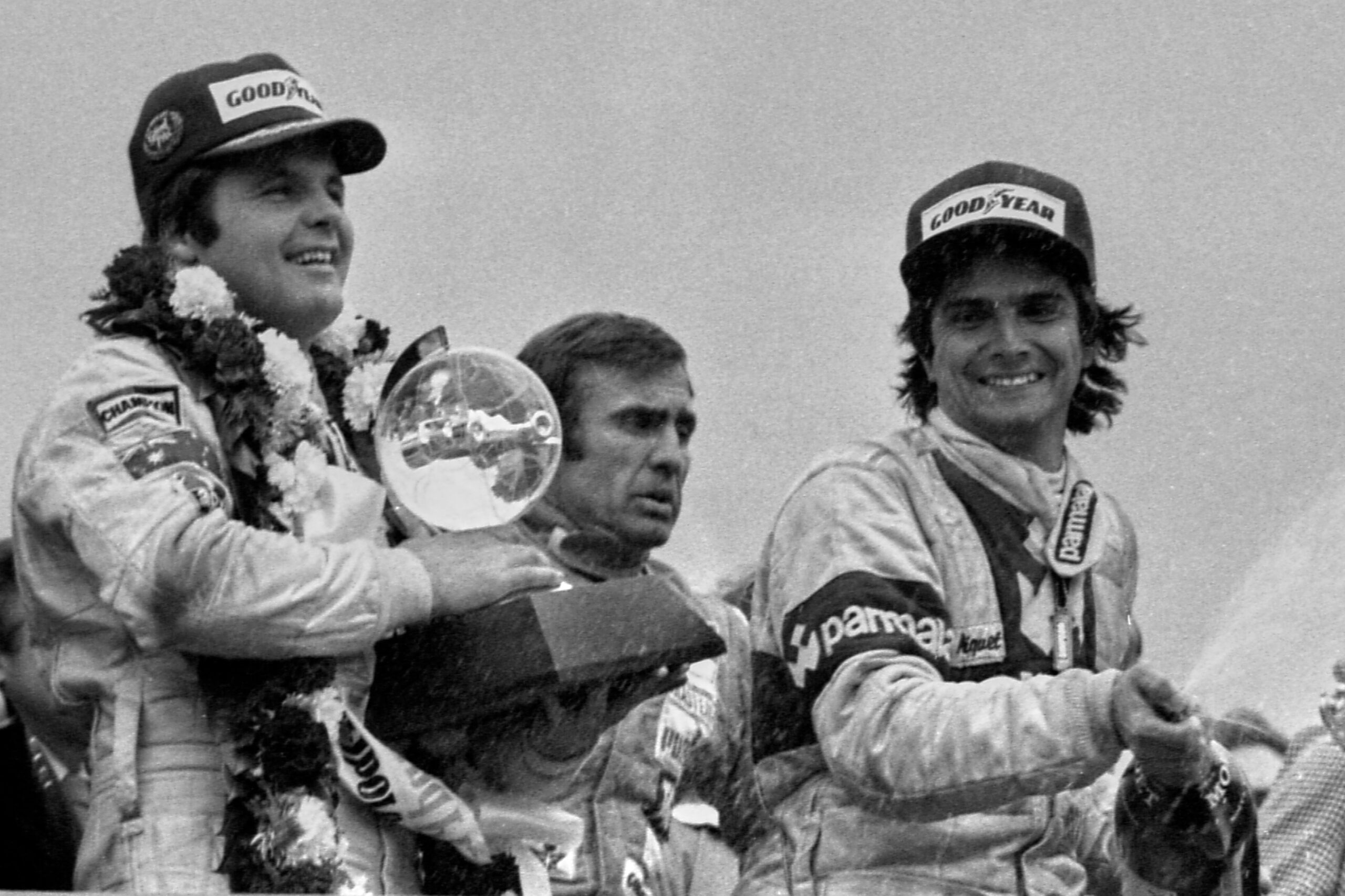
Alan Jones, the Australian who became the first driver to win the Formula 1 title for Williams, has died after a brief illness. He was 80.
“We are extremely saddened to announce the passing of our beloved Alan,” his wife, Amanda, said in a statement on Thursday. “He will be dearly missed and fondly remembered by those closest to him, as well as the many fans whose support he was always grateful for.”
Jones was the second and last Australian to win the world championship in an F1 career that featured 12 victories and 24 podium finishes. He followed Jack Brabham, a three-time champion in the 1950s-60s.
Williams said Jones formed an “extraordinary bond” with the team’s founders to win the title in its fourth season as an F1 constructor.
“He set the standard for Williams champions: a fast, uncompromising racer with a challenger mentality who loved motor racing and dedicated his life to it,” Williams said in a statement. “He is a true Australian icon and a Williams legend, and he will be dearly missed. We send our love and thoughts to the Jones family and all his friends.”
F1 chief executive Stefano Domenicali hailed “a true great of our sport and an extraordinary racer,” adding: “Alan was a formidable competitor, a natural leader and an icon who inspired generations of fans, particularly in his beloved Australia.”
Jones was known for his aggressive driving style and abrasive personality. “If someone passed me, I took it personally,” he said on a 2019 podcast.
In an era when deaths and serious injuries weren’t uncommon in F1, Jones started each year by checking his life insurance and making travel plans for his wife to return to Australia if he was killed, but said he never personally feared death in a race.
“I never worried about the dangers,” he said. “I worried about the money.”
Success was far from assured in Frank Williams’ second attempt at launching an F1 team after years toward the back of the grid.
Frank Williams was adept at defusing Jones’ temper and keeping him focused, car designer Patrick Head was at the cutting edge of F1 thinking, and wealthy Saudi Arabian sponsors funded the team to deliver on its ambitions. On top of that, Jones’ driving style and physical strength were a good fit for the team’s FW07 car.
Jones was runner-up in 1979 before going one better in 1980. He didn’t seek to make friends with other F1 drivers.
“They were just things that had to be passed,” was how he described his rivals in the 2019 podcast “Beyond The Grid.” After one public feud with his Argentine teammate Carlos Reutemann, Jones needed a police escort for his next race in Argentina.
Disappointed that Ferrari went back on what Jones later claimed was a signed contract for him to drive for the Italian team in 1977, he bore a grudge.
“When I used to drive down pit lane and they were working on their cars, I’d give them a little wave,” he said later. “Now, I might have only used one finger but it was a wave!”
Jones was born in Melbourne in 1946 and was the son of a successful amateur racing driver. He moved to Britain in the late 1960s and funded his journey to F1 by buying and selling old vans.
Jones drove for small teams when he arrived in F1. His first win for Shadow in 1977 from 14th on the grid came as such a surprise to organizers of the Austrian Grand Prix that they hadn’t prepared a recording of the Australia anthem for the podium ceremony. Jones later recalled that “a drunk played ‘Happy Birthday’ on a trumpet” instead.
After an unsuccessful title defense in 1981 — Jones believed he’d driven better than before but the car let him down — he headed back to Australia and bought a farm. Homesickness and a dislike for the British weather played a part.
Still, Jones was soon bored of his new life as a cattle breeder and made a one-off F1 comeback in 1983 with Arrows before returning with Haas — no relation to the current F1 team of the same name. The car wasn’t competitive and Jones had a best finish of fourth before leaving F1 again in 1986.
Away from F1, Jones won the 1978 Can-Am sportscar title and was third in his only IndyCar race in 1983. Jones kept racing in Australia’s V8 Supercars series until 2002, when he was 55.
He was inducted into the Australian Motorsport Hall of Fame and Sport Australia Hall of Fame.
Jones stayed around the paddock as a TV commentator and race steward but was critical of modern drivers, who he called “prima donnas” and “too corporate.”
Original team owner Frank Williams, who died in November 2021, was fond of Jones and once described him as “a man’s man” who was “great fun to be with.”
“He never needed propping up mentally, because he was a very determined and bullish character,” Williams said. “He didn’t need any babysitting or hand-holding and that’s the way it should be. It shouldn’t be necessary for me to ask a driver if he is happy, or if he needs his underwear changed.”
Stay on top of the issues that matter to you the most.