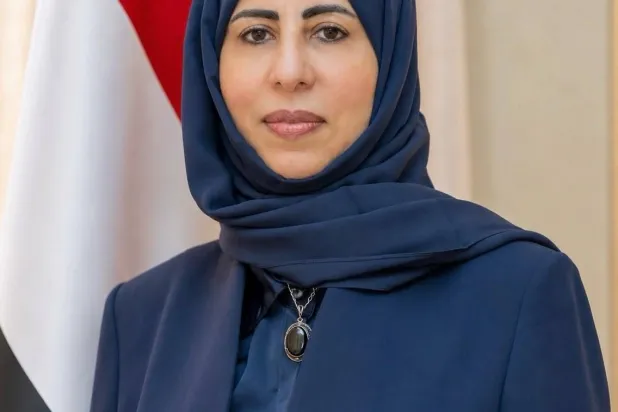
Yemeni Minister of Foreign Affairs and Expatriates Dr. Afrah Al-Zouba said the Yemeni government has entered a phase of restoring the state after exhausting opportunities for de-escalation, stressing that any future political process must end with the return of state institutions and the state having sole control over weapons and decisions of war and peace, rather than power-sharing with an armed group. In an interview with Asharq Al-Awsat, Al-Zouba said: “We have not abandoned peace, but rather the illusion of peace that leaves weapons outside the state,” stressing that the goal of the current phase is to end the coup and extend state authority over the entire national territory. She added: “The Yemenis’ right to their state cannot remain suspended at the will of an armed group.” The minister linked the restoration of the state to regional security and international maritime navigation, saying: “The security of Bab el-Mandeb begins on the coast, and protecting ships at sea will remain an incomplete solution as long as the land is a launching point for threats to it.” The foreign minister praised Saudi political, military and economic support, while stressing that the success of the phase “will not be measured by the number of cities restored, but by the number of citizens who regain their security and families who return to their homes.” Restoring the State as the Path to Peace Al-Zouba explained that the decision to enter the phase of restoring the state was announced by President of the Presidential Leadership Council Dr. Rashad Al-Alimi, based on constitutional responsibility and in accordance with the decisions of the National Defense Council, after opportunities for de-escalation had been exhausted, with the aim of preserving Yemen’s unity, sovereignty, independent decision-making and territorial integrity. She recalled the president’s assertion that “Yemen’s Dawn” is not merely the name of a military operation, but a promise that the war will end with a state and that Yemenis will regain their republic and their future. She noted that behind the armed forces are political and societal forces rallying around the state project and supporting its institutions. The minister said the state had given peace efforts their full time and opportunities, but the Houthis responded with further mobilization and escalation and expanded their attacks against civilians, national facilities, neighboring countries and international waterways. She added that experience had demonstrated the fragility of de-escalation as long as the group is capable of rearming and imposing its will on society, stressing that “every settlement that leaves the state’s decision hostage to weapons postpones the war rather than ending it.” Al-Zouba stressed that the force used by the state is a means of protecting citizens and enforcing the law, not a substitute for politics. As for diplomacy, she described it as “proactive rather than merely reactive,” explaining that it sets out the operation’s objectives and legitimacy, mobilizes support for it, accompanies the humanitarian response and prevents the Houthis from being treated as a parallel authority to the state. International Support Awaits Practical Programs The minister spoke of growing support for Yemeni state institutions and a broader recognition of the link between their ability to extend their authority and regional security and maritime safety. She said this was reflected in her communications and meetings on the sidelines of the 81st session of the United Nations General Assembly last month. Alongside Saudi and Gulf support, the minister pointed to calls by members of the UN Security Council for practical cooperation with the government to prevent the Houthis from obtaining weapons, technical assistance, training and financing. She also noted London’s affirmation of Yemen’s and Saudi Arabia’s right to defend their security and sovereignty under international law, the European Union’s renewed support for the Yemeni government and people, and Japan’s continued efforts to build the capabilities of the coast guard. But she stressed that “the real measure is the impact of these positions on the state’s ability to protect its citizens and restore its institutions,” identifying three priority tracks: strengthening defense and security capabilities on land and at sea, enforcing the arms embargo under Resolution 2216 to cut off Iranian supplies, and providing the government with economic, development and humanitarian support. The foreign minister said strengthening maritime capabilities is based on the international partnership for Yemeni maritime security, coordination with the Saudi-led multinational defensive maritime coalition, and relevant existing frameworks. She revealed that the government will present detailed needs to its partners, looking to translate support into “practical programs with clear timelines.” According to Al-Zouba, the Houthis have targeted more than 100 commercial vessels since November 2023, sinking several, damaging dozens of others, hijacking a vessel and detaining dozens of crew members. Their attacks have resulted in the deaths of sailors and Yemeni rescuers. She said countries bearing the cost of disrupted trade and higher shipping and insurance costs have a direct interest in enabling Yemen to secure its coastlines. Washington: Declared Support and Ongoing Coordination Al-Zouba described the declared US position as clearly standing with the Yemeni government, noting Washington’s assertion that the Houthis initiated the confrontation and must bear its consequences, and that the legitimate government has the right to defend its people and end the group’s ability to engage in terrorism. She said Washington called at the UN Security Council for the Houthis to withdraw from areas they had seized, end Iranian support and fully implement the arms embargo. She also noted that the US assistant secretary of state for Near Eastern affairs renewed, during their meeting in New York, his support for the government and the Presidential Leadership Council, as well as continued coordination on security, stability and counterterrorism. She quoted US Secretary of State Marco Rubio as saying that the operations came in response to the Houthi attack and to retake territory they had seized, and that the Yemeni government and Saudi Arabia would not accept the group controlling Bab el-Mandeb. She declined to discuss specific military or intelligence commitments, saying: “I am committed, when discussing them, to what is officially announced through the relevant channels.” The minister confirmed that the government is working with Washington on tangible cooperation proportionate to the threat: “We are not asking anyone to take its place, but rather to enable it to carry out its duty by strengthening the capabilities of its institutions and supporting its economic stability.” She warned against selective Houthi assurances that they would not target ships belonging to certain countries, saying such assurances leave the group capable of attacking others, give it time to rearm and consolidate its control over the coast. She said: “Freedom of navigation is a right guaranteed by international law to all states, not a privilege granted by an armed group and withheld according to its terrorist agenda and in a manner that serves the Iranian regime.” Iranian Supplies and Accountability Al-Zouba said the evidence the government presents to its partners regarding Iranian support consists of “documented evidence, not political assessments.” She described the relationship as an extended military and strategic one that predates the coup, citing the seizure of the vessel Jihan 1 in an arms-smuggling case announced by the government in early 2013. She referred to the findings of the UN Panel of Experts regarding the role of the Quds Force, Hezbollah, and Iraqi experts and technicians in transferring equipment and providing training and assistance to the Houthis, and said the group could not develop complex systems without external support. She added that Yemeni forces seized, in a single operation last year, more than 750 tons of weapons and equipment bound for the Houthis, including anti-ship and anti-aircraft missiles, drone engines and radar equipment. Some of the equipment displayed characteristics similar to systems manufactured in Iran, and Persian-language operating manuals were found with it. Al-Zouba cited remarks by the commander of the Quds Force in June about a “security belt” extending from Hormuz to Bab el-Mandeb, considering the linking of the two waterways a compounded threat to energy and trade security. She also cited Rubio’s reference to direct flights from Tehran to Yemen carrying members of the Revolutionary Guard Corps. Nevertheless, the foreign minister stressed that the Yemeni issue should not be reduced to the confrontation with Iran, because the Houthis have their own project and interests in retaining power, weapons and resources, and their threat will not automatically end with any de-escalation with Tehran. She noted arrangements that the Panel of Experts said it had documented with Somalia’s al-Shabaab movement involving arms smuggling and training, and with al-Qaeda involving security coordination and the continuation of a cessation of hostilities between them. She stressed: “We distinguish between documenting the support system and proving direct management of a particular attack. Each has its own evidence.” She called for suppliers, intermediaries and financiers to be pursued, procurement, transport and smuggling networks to be dismantled, the transfer of military technologies and expertise to be halted, and information-sharing and accountability for violations of the arms embargo to be strengthened. The Day After: Institutions and Services Without Retribution The minister outlined the government’s vision for restored areas as one centered on the return of security, civilian administration, services and the rule of law. She explained that the president had directed the preparation of a parallel plan for the operations under which institutions would begin operating in every city and district that is restored. Priorities include resuming the payment of salaries and addressing outstanding dues, an urgent recovery and reconstruction program covering roads, electricity and water, facilitating the return of displaced people and reviving the economy, with support from brothers and friends. Al-Zouba stressed that protecting civilians, respecting international humanitarian law and facilitating aid are obligations during and after the operations, saying: “This is not a war against the people of Sanaa or Saada or any governorate, nor against a sect or tribe.” She stressed the state’s responsibility toward citizens in areas under Houthi control, saying that “there is no place for revenge or collective punishment, and the door to amnesty and safe return remains open in accordance with the announced procedures.” The minister kept the political track open for a just and comprehensive peace based on the approved references, constitutional legitimacy and equal citizenship. But she stressed that its essence is “ending the coup and restoring institutions, not sharing power with weapons,” and that participation is a right for anyone who complies with the constitution and the law. Saudi Support and the Partnership to Restore the State Al-Zouba described coordination with Saudi Arabia as close and continuous politically, militarily, developmentally and in relief efforts, governed by a strategic partnership and a single objective: ending the coup and restoring the state. She praised the Saudi Council of Ministers for renewing, at its latest session, its full support for the Presidential Leadership Council, the government and the Yemeni people. She said Saudi support had contributed to the resilience of state institutions, strengthened national consensus and cohesion, and that budget support, fuel supplies for power plants, and humanitarian and development assistance all help the government meet its obligations and alleviate citizens’ suffering. On the ground, the foreign minister explained that the Coalition to Support Legitimacy has provided air and operational support since the launch of “Yemen’s Dawn,” and confirmed that this support would continue until the restoration of the institutions. She noted that the advances by forces along the western coast, around Bab el-Mandeb and on other fronts were the result of their sacrifices and cohesion and of the national will, alongside “this influential support.” She renewed solidarity with Saudi Arabia in confronting Houthi attacks, which she said had reached the point of threatening holy sites, and expressed support for its right to protect its security and sovereignty. She welcomed the “Mecca Defense Alliance” moving toward the practical implementation of its collective defense commitments. She stressed that the Houthis do not represent the Republic of Yemen or the will of its people, and that restoring the state is a pillar of security for Yemen and its neighbors. Aden Airport: An Attack on the Lives of Yemenis Al-Zouba described the targeting of Aden International Airport as a “terrorist attack targeting a civilian facility serving Yemenis from different governorates,” striking at their right to travel, receive medical treatment and return to their families. She said, based on the announcement by the relevant authorities, that one of the two missiles fell near the runway minutes before a flight arriving from Cairo was due to land and was forced to divert to Jeddah, while passengers, workers and air crews were within the danger zone. She added that the move to protect lives does not lessen the gravity of an attack “that could have turned a civilian flight into a humanitarian catastrophe within moments.” The minister linked the attack to the shelling of the airport when the government arrived in late 2020, which resulted in more than 100 people killed and wounded, the detention of four Yemenia aircraft in 2024, and the disruption of the return of more than 1,000 pilgrims, in addition to attacks on the airports of Jazan and Najran and threats to aircraft transiting Saudi airspace. She considered the timing of the attack an attempt to shift the confrontation from the battlefield to the lives and services of citizens, calling for measures beyond condemnation, including holding those who planned and carried out the attack accountable, depriving the Houthis of missiles and drones, and preventing the use of civilian flights as cover for military support. She said the government welcomed the Jordanian initiative to operate flights between Amman and Sanaa to serve citizens and patients, while the Houthis rejected it and sought to operate flights not coordinated with the state. She called on the International Civil Aviation Organization to condemn the attack, assist in assessing risks and enhance safety, stressing: “Aden Airport will remain a civilian gateway for Yemenis, operating in accordance with safety requirements.”