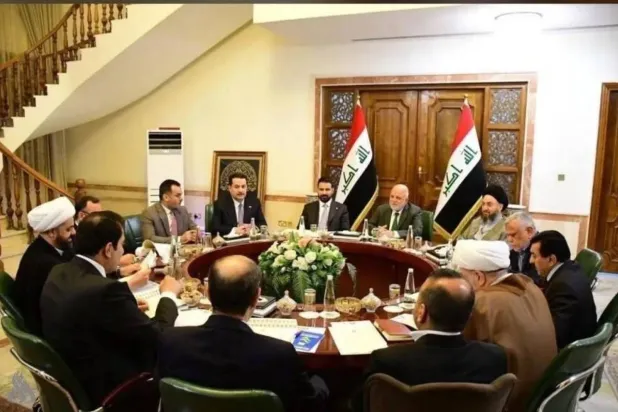
Iraqi Prime Minister Ali al-Zaidi has warned the Shiite Coordination Framework of the consequences of failing to meet agreed deadlines for bringing weapons under state control, as Washington reaffirmed that its economic partnership with Baghdad was moving forward. Al-Zaidi hosted a meeting of Coordination Framework leaders late Saturday, stressing the need to resolve outstanding issues, including completing the formation of his Cabinet and regulating weapons in a way that strengthens state sovereignty and security in Iraq and the wider region. An informed source told Asharq Al-Awsat that al-Zaidi also stressed the need to support the work of a four-party committee negotiating with armed factions to reach a final agreement on handing over weapons to the Popular Mobilization Forces within agreed timelines. The prime minister also briefed the meeting on key issues discussed with the US administration during his recent visit to Washington and the potential economic, political and security consequences for Iraq if the weapons issue remains unresolved, the source added. The warning coincided with a message from US Secretary of State Marco Rubio marking Iraq’s National Day on Oct. 3. Rubio pointed to al-Zaidi’s July visit to Washington and his meeting with President Donald Trump at the White House, noting that it reaffirmed the friendship between the two countries and their shared commitment to a strong and prosperous future. He added that economic partnerships announced during the visit demonstrated the potential for trade and investment cooperation between US and Iraqi companies, while welcoming Iraq’s efforts to strengthen its sovereignty and contribute to regional security and stability. Another informed source told Asharq Al-Awsat that Washington understood the difficulties al-Zaidi faced in dealing with armed groups and political forces, including some within the Coordination Framework, that appeared reluctant to embrace his plan. According to the source, the Framework’s shift toward relatively longer deadlines for surrendering weapons followed a private meeting between al-Zaidi and Trump without other members of the Iraqi delegation. The source also cited Trump’s response to al-Zaidi’s request for an exemption allowing Iranian flights to land at Najaf airport. In a National Day address, al-Zaidi described Iraq as a state that “makes its own decisions and protects its land and airspace,” with weapons subject to the commander-in-chief of the armed forces. He declared that Iraq had completed its sovereignty on Sept. 30, 2026, with the end of the international coalition’s military mission, adding that political instability had cost the country significant development opportunities and repeatedly forced it “back to square one.” Al-Zaidi also highlighted his government’s efforts to protect Iraq’s interests, security, sovereignty and national decision-making from the repercussions of regional conflict while pursuing a balanced foreign policy based on national interests and mutual respect. He outlined government efforts to diversify the economy, empower the private sector and link public spending to results. He also cited plans to provide one million residential land plots, establish a fund for future generations and economic cities, and implement the Development Road project to turn Iraq into a trade and energy corridor and investment hub linking East and West. Political and strategic affairs researcher Hani Ashour told Asharq Al-Awsat that the departure of US and international coalition forces made restructuring Iraq’s security strategy increasingly necessary, particularly by bringing factional weapons under state control and strengthening the armed forces. Ashour, however, pointed to major obstacles, including Iraq’s economic difficulties following the closure of the Strait of Hormuz and political forces’ preference for dialogue with armed factions. Such negotiations, he cautioned, could drag on and remain tied to the US-Iran conflict and its repercussions, potentially giving armed factions renewed justification to retain their weapons and reaffirm their allegiance to Iran. A meeting of the Coordination Framework attended by Prime Minister Ali al-Zaidi (Iraqi News Agency)