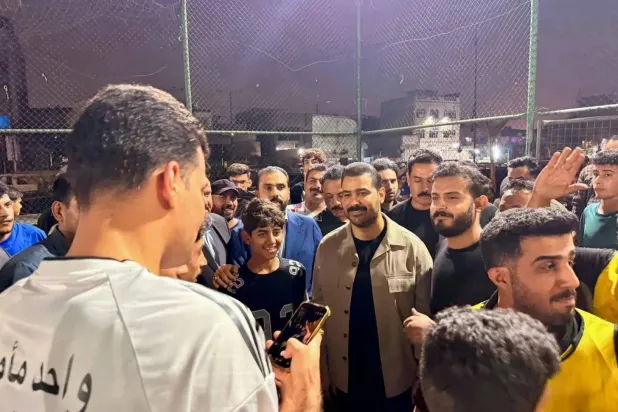
The Iraqi Kataib Hezbollah, one of the armed factions that still refuses to disarm, responded to Prime Minister Ali Al-Zaidi's announcement regarding its possession of investments worth billions of dinars and millions of dollars. The premier has launched what political observers in Baghdad view as an "open battle" against the armed factions, vowing that he "will not let them remain." Over recent days, Al-Zaidi canceled multi-million dollar contracts across various locations, ranging from Baghdad Airport and the Ministry of Transport to Mosul Airport. Websites close to the government circulated the names of the armed factions that had control of those contracts. Al-Zaidi dismissed statements issued against him and his associates, including his own brother, by Kataib Hezbollah, choosing Sadr City in eastern Baghdad to assert his firm stance. Visiting the popular district late Saturday night, he met directly with citizens at a local restaurant and delivered a clear message to armed factions, signaling the start of an open and uncompromising confrontation. In his most critical message directed at the factions, he declared: "I will absolutely not let weapon holders remain," adding, "If others allowed them to remain, it was because they were benefiting from them." Al-Zaidi's response to the armed factions came a day after accusations were leveled against his brother by Kataib Hezbollah, which said in a statement: "We address our remarks directly and explicitly to Hassan Al-Zaidi, the media and security official in the Prime Minister's office. All your allegations regarding investments, companies, and the like - whether accurate or completely fabricated slanders - we consider entirely, along with all their dependencies, a 'gift' to you from the Brigades, to be added to your assets." On Saturday, Al-Zaidi directed the cancellation of contracts for three companies at Mosul Airport due to their links to armed groups, ordering their referral to international firms. It has become clear that the initiative to restrict weapons to state control is facing growing setbacks, following announcements by armed factions such as Kataib Hezbollah, Al-Nujaba, and Kataib Sayyid al-Shuhada of their refusal to surrender their arms. This contrasts with other factions, most notably Asaib Ahl al-Haq and Kataib Imam Ali, which complied and secured ministries, agencies, and embassies in exchange for their stance. The current truce remains tied to the potential military confrontation between the US and Iran, amid leaks that the Americans delivered a warning to Al-Zaidi regarding potential strikes on those factions should they move against neighboring countries or US bases in the region. Meanwhile, political forces, particularly certain factions represented by the Coordination Framework, have kicked off efforts to prevent the confrontation between the government and the factions from widening because it has started to impact upon "one of the most critical areas that everyone was keen to avoid over the past years: economic committees and investments," said a well-informed Iraqi politician and lawmaker close to both sides. Speaking on condition of anonymity to Asharq Al-Awsat, the Iraqi lawmaker and politician noted that "certain forces within the Coordination Framework, during talks between some of its factions and the armed groups, have begun leaning toward the factions' refusal to disarm under Al-Zaidi's vision.” “This shift follows Al-Zaidi's understandings with the US and President Donald Trump, whom he met twice - first during a visit to Washington last July, and second in New York during the UN General Assembly meetings last September - as it became clear to some Framework leaders that the Al-Zaidi-Trump agreement might not stop at the weapon, but could extend to other factions within the Shiite political structure,” he added.