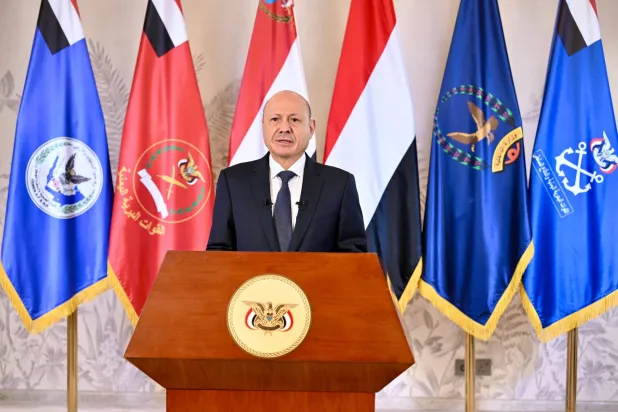
Yemeni Presidential Leadership Council Chairman Rashad Al-Alimi on Sunday announced the start of military operations to reclaim the remaining territory of the republic and extend the authority of the state and its institutions across the entire country, marking an official transition from a phase of preparation and mobilization to open military action. In an address to the Yemeni people, Al-Alimi said the decision to begin the operations was taken after the necessary procedures and measures had been completed and based on decisions by the National Defense Council. He said he had instructed the armed forces, security forces, and all military formations to carry out their duties according to approved plans "until the country is liberated from the grip of the terrorist militia." Al-Alimi justified the decision by saying that opportunities for de-escalation had been exhausted. He said the state had given peace sufficient time and opportunities, while the Houthi group had responded with further mobilization, escalation, attacks, and threats against civilians, national facilities, neighboring countries, and international waterways. He stressed that the announced battle is not a war against residents of areas under Houthi control, nor against any sect or tribe, but rather "a battle for the state and its citizens and to restore its institutions." He said its objective is to end the seizure of Yemenis' will and political future through the use of force. Al-Alimi delivered a direct message to residents in Houthi-controlled areas, calling on them to stay away from military positions, gatherings, and supply routes, and to protect their children from being drawn into the fighting. At the same time, he reiterated the state's commitment to the safe return and declared amnesty for those who lay down their weapons and stop fighting alongside the group. In a message to government forces and the resistance, the chairman of the Presidential Leadership Council stressed that the mission is "not only to reclaim the land, but to restore the state to it." He called for the protection of civilians and property and adherence to the law, stressing that there would be no room for revenge, retaliation, or attacks on innocent people. Directives to the Government On the civilian front, Al-Alimi said he had instructed the government to prepare a program of action to run in parallel with the military operations, so that state institutions would begin assuming their responsibilities in areas reclaimed by government forces as they are recovered. The priorities he outlined include resuming the payment of state employees' salaries and addressing outstanding dues retroactively, launching an urgent recovery and reconstruction program, repairing damaged roads, electricity and water networks, and facilities, and creating conditions for the return of displaced people and the resumption of economic activity. Al-Alimi said the success of the battle would not be measured by the number of cities reclaimed, but by the number of citizens who regain security, families that return to their homes, and measures that prevent a return to practices of killing, oppression, and depriving the people of their will. He also reiterated the commitment of the Presidential Leadership Council and the government to the outcome of the Saudi-sponsored south-south dialogue, in a manner that ensures a fair and comprehensive solution to the southern issue. He called on brothers and friends, as well as the international community, to support Yemen, its armed forces, and national institutions, and to support humanitarian and economic efforts and recovery and reconstruction programs. Al-Alimi concluded by announcing that the state's military, security, and civilian institutions had entered a "state of full mobilization" until the mission was accomplished, stressing that the new phase seeks to restore the state to its territory and institutions and return weapons to their "natural place under the authority of the law."