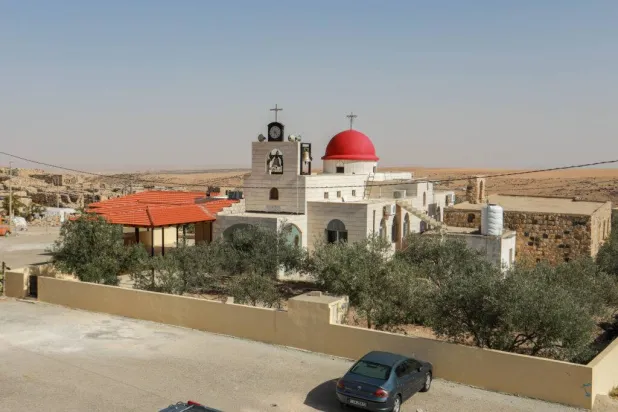
A terrorist attack targeting mourners attending a funeral at St. George Greek Orthodox Church in Hamoud village, in southern Jordan's Karak Governorate, has drawn attention to one of the Kingdom's historic Christian communities and renewed interest in the church and its location. Initial reports indicated that two gunmen got out of a vehicle and opened fire during the funeral, while Jordan's Public Security Directorate announced that it was pursuing the suspects. Al-Mamlaka television reported Saturday that the death toll from the Karak church attack had risen to eight, while Jordan's Public Security Director said 40 people had been wounded. The church is commonly referred to in media reports as Hamoud Church, after the village where it is located. Its official name honors St. Georgios, also known as St. George, and it is among the churches affiliated with the Greek Orthodox Patriarchate of Jerusalem in Jordan. Karak Governorate holds an important place in Jordan's history and is home to Christian communities that have lived alongside the Muslim majority for generations. Churches belonging to different Christian denominations are found throughout the governorate. The following is an overview of the church, its history and the Christian presence in Karak and Jordan. Where Is Hamoud Church, and What Is Its Religious Significance? St. George Greek Orthodox Church is located in Hamoud village in Karak Governorate, approximately 118 kilometers south of the capital, Amman. According to the official directory of churches affiliated with the Greek Orthodox Patriarchate of Jerusalem, it is one of the patriarchate's churches in Jordan. The church is named after St. Georgios, also known as St. George, who holds a prominent place in Eastern Christian tradition. The church forms part of the Orthodox Christian presence in Karak Governorate, which is also home to churches belonging to other Christian denominations. The Latin Patriarchate of Jerusalem notes that the governorate has Latin Catholic, Greek Catholic and Greek Orthodox communities, reflecting a Christian presence with deep historical roots. Karak: A Long History of Christianity and Religious Coexistence Karak Governorate is one of Jordan's regions with a historic Christian presence, dating back to the Byzantine era, when the area served as an episcopal center with several churches, according to a historical report published by the Latin Patriarchate of Jerusalem. This Christian presence is not limited to Karak city, the governorate's administrative and historical center, but extends to several villages and towns, including Hamoud, Smakieh, Adir, Rabba and Qasr. The governorate is home to Greek Orthodox, Latin Catholic and Greek Catholic churches, alongside mosques and other Islamic places of worship. Over the years, the role of churches in Karak has extended beyond religious services to helping establish schools and health centers serving both Christians and Muslims, making them an integral part of the region's social and educational life. What Is Karak's Population, and Where Are Its Christian Communities Concentrated? Karak Governorate has a population of approximately 375,000, while estimates by Jordan's Department of Statistics put the figure at 395,400 at the end of 2025. Historically, Karak has been home to several Christian families and clans, including the Hijazeen, Halasa and Akasheh, according to the Latin Patriarchate of Jerusalem's historical report. The report notes that these families have formed part of the city's social fabric alongside Muslim clans. Some Christian families are concentrated in particular neighborhoods, including the area known as the Christian Quarter in central Karak, where Christian and Muslim families have lived alongside one another for generations. The governorate is characterized by a strong tribal identity and religious diversity. Its social and religious diversity is reflected in the presence of Christian institutions and churches alongside mosques and other Islamic places of worship. The World Council of Churches highlights the historical ties between Christians and Muslims in Jordan, emphasizing the importance of preserving places of worship and protecting freedom of religious practice. Christians in Jordan: What Percentage of the Population Do They Represent, and Which Denominations Do They Belong To? Christians constitute a religious minority in Jordan, accounting for an estimated 2 to 3 percent of the population, according to Jordan's Ministry of Tourism and Antiquities. The Kingdom's Christians belong to several denominations, including Greek Orthodox, Catholic, Armenian Orthodox and Protestant communities, with churches located in different parts of the country. Has Karak Experienced Similar Attacks Before? Karak Governorate experienced a deadly terrorist attack in December 2016, claimed by ISIS, that targeted civilians and security forces. The attack killed 10 people, including seven security personnel and a Canadian tourist, and wounded 34 others. Four ISIS militants were also killed after barricading themselves inside the historic Karak Castle. Reuters described the latest attack as a rare assault targeting Jordan's Christian minority.