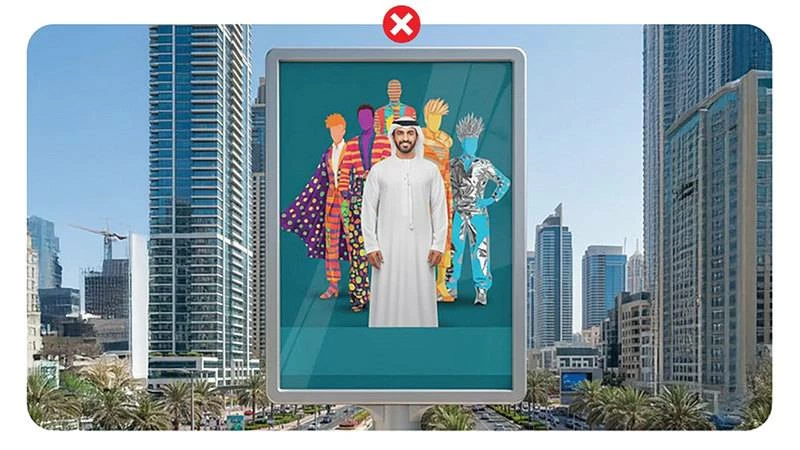
Dubai: The Guide to Regulating Advertising Content in the Emirate of Dubai, recently issued by Dubai Municipality, revealed controls and standards that define what is permitted and prohibited in terms of phrases, images, symbols, and visual and audio effects on fixed and digital billboards.The guide aims to reduce visual pollution, protect traffic safety, prevent marketing deception, and preserve societal values and national identity. The guide prohibited unsubstantiated medical claims, such as “the best 100% guaranteed treatment” and “cures all diseases,” marketing exaggerations, such as “unparalleled in the world,” and advertising “discounts up to 99%” without clarifying the conditions and categories included. It also stipulated that the Arabic language must occupy at least 50% of the advertisement space and be more prominent than the English language.The guide prohibited displaying men in transparent or very tight clothing, or clothing that does not cover the chest, shoulders, and knees. It also prohibited displaying women's underwear in outdoor advertisements, and stipulated that women's clothing must cover the shoulders completely, the chest up to the upper neck, the arms up to the elbows, and the legs up to their mid-calf. It also prohibited excessive makeup, visible tattoos, and piercings in unconventional places on the face. Furthermore, it prohibited non-citizens from wearing the Emirati national dress in advertisements, or using it in a vulgar manner or in inappropriate situations and places. Finally, it prohibited the exploitation of children in advertising, or the publication of their pictures and data without the permission of their parents.Arabic in focusIn detail, the “Guide to Regulating Advertising Content in the Emirate of Dubai,” recently issued by Dubai Municipality, has set clear linguistic rules for advertising content. It stipulates that the Arabic language must be used correctly in advertising billboards, both grammatically and spelling-wise, and in well-known and clear Arabic fonts. It allows the use of English alongside Arabic, provided that the Arabic is more prominent, occupies at least 50% of the total advertising space, and is placed at the top or on the right side, according to the specified regulations.The guide prohibits the use of vulgar dialects or unclear colloquial words, while allowing common and familiar expressions in the UAE. It stipulates that phrases must be clear, logical, and concise, allowing them to be read and understood quickly, especially in advertisements viewed by road users from inside vehicles.The use of moving text that may distract drivers, or placing writing on people’s faces that obscure their features, as well as ambiguous or unclear phrases that may require an official explanation from the advertiser when requested, is prohibited.The guide stressed the need to avoid literal translation of foreign texts when it leads to distorting the Arabic meaning or producing awkward phrases. It also prohibited the use of offensive or provocative popular phrases, such as “whoever doesn’t buy will regret it” and “be a man and get it,” and set controls for the use of national phrases and official initiatives in commercial campaigns, preventing their use in a way that suggests sponsorship or official status without authorisation.Prohibited phrasesThe guide prohibited the use of misleading phrases and marketing exaggerations that may deceive the consumer about unreal features, or make unclear promises about products and services, including advertising “discounts up to 99%” without specifying the categories covered and the conditions of benefit, and phrases such as “crazy discount,” “no one can match our services,” “get unlimited full membership,” and “unparalleled in the world.”The ban included texts that contained sexual innuendo, inappropriate expressions, or double meanings, such as “the hotel of hidden happiness and guaranteed pleasure,” as well as phrases that used religious vocabulary or suggested miracles and supernatural abilities for commercial purposes.The guide also prohibits medical and health claims that assert results that cannot be scientifically proven, or suggest that a product or service can cure all diseases or achieve a guaranteed complete cure, such as “the best 100% guaranteed treatment,” “cures all diseases,” and “the only 100% safe product,” as well as statements that promise exceptional results without reliable evidence.Clothing and photosRegarding images and visual content, the guide stipulated that advertisements must conform to public taste and local customs and traditions, and prohibited the display of men in transparent or very tight clothing, or in a way that highlights body details inappropriately, with the necessity of covering the chest, shoulders and knees at least, and that the style of clothing should reflect the prevailing public taste in the country.The display of women’s underwear in outdoor advertisements is strictly prohibited, as is the use of images that suggest seduction or aim to attract attention in a manner inconsistent with public morals. It is also stipulated that the appearance of women in advertising images must be unpretentious and express dignity and seriousness, while prohibiting exaggerated body gestures, facial expressions, or unnatural hand movements that carry inappropriate connotations.The use of a woman's image as an advertising tool without a direct connection to the product or service was prohibited, stressing the need to focus on the product or service itself, and not on the attractiveness of the woman.The guidelines specify dress codes for women in advertisements, including full coverage of the shoulders, chest to the upper neck, arms to at least the elbows, and legs to mid-calf. They also prohibit heavy or excessive makeup deemed inappropriate in public. Furthermore, models are strictly forbidden from displaying visible tattoos, whether permanent or temporary, while traditional henna designs in natural brown or red hues, typically applied to the hands, are permitted as part of accepted Emirati traditions and customs.Images of women that include a piercing in the chin, between the eyebrows, on the forehead, on the tongue, or in other unacceptable places on the face or body have been banned, while piercings in the ear and nose in the traditional manner that conforms to customs and traditions are allowed.The guide allowed the display of the traditional heritage anklet ("hajal") within a picture of a woman wearing traditional national dress, while it prohibited the display of the anklet, whether traditional or modern, with a regular dress, as it is one of the elements that may carry inappropriate connotations in advertising content.National costumeThe guide addressed regulations concerning Emirati national dress, including the kandura, ghutra and agal for men, and the abaya and sheila for women, as elements associated with national identity, and prohibited non-citizens from wearing Emirati national dress in advertisements, in order to preserve Emirati identity.It was stipulated that the national dress be displayed in a manner that respects its social and traditional status, without vulgarity or trivialisation, and that it appear clean, pressed, and worn correctly in a way that reflects respect and prestige, while prohibiting modifications to its original design, whether in the cut of the kandura or the abaya, or the way of wrapping the ghutra and sheila, in a way that distorts its shape or takes it out of its traditional character that is known.It stressed the need to display the national dress in its entirety, without any tampering or modification that would compromise modesty or respect, and to prevent opening the kandura or modifying the abaya in a way that reveals the body or violates modesty, while stipulating that the posture of the person wearing it must be appropriate and decent, and free from physical suggestions or behaviours that contradict the dignity and authentic customs of Emirati society.It also prohibited the depiction of local costumes in sarcastic or vulgar humorous contexts, or their use in inappropriate advertisements, and banned the use of national dress as a vulgar commercial attraction tool, or to promote products that are not related to the local culture, or to give an artificial ‘national character’ to a product or service that is not intrinsically related to Emirati identity.The guide prohibited the use of national dress in cases of gender reversal, or its redesign in a vulgar or unconventional manner, stressing that only men should wear the men’s national dress, represented by the kandura, ghutra and agal, and that women should wear the women’s dress, represented by the abaya and sheila.It also prohibited people wearing Emirati national dress from appearing in inappropriate places or situations, such as nightclubs or noisy parties, or in situations that violate public morals, in order to preserve its social and cultural status and symbolism.Child exploitationIn the context of protecting children, the guide was based on the controls related to the Child Rights Law (Wadeema’s Law) issued under Federal Law No. (3) of 2016, and the prohibition of using children’s images in advertisements in an inappropriate or abusive manner, or exploiting them in promoting products that harm their health.It also prohibited the publication of children’s photos or personal data without parental permission, or the circulation of content that could reveal their identity or put them at risk. It also prohibited the broadcasting or publication of advertising content that could negatively affect their mental health, including scenes of violence, inappropriate suggestions, and frightening scenes.The ban included advertisements that might encourage children to engage in harmful behaviours, or promote concepts contrary to moral and cultural values, and advertisements directed at them that contain misleading information or false promises, while taking into account the psychological and moral impact of advertising content directed at children or in which they appear.