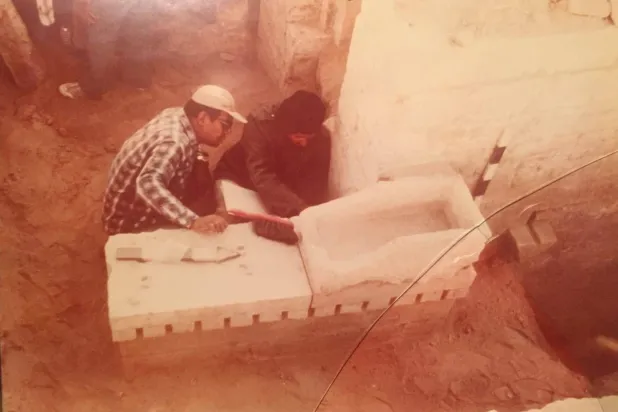
As International Archaeology Day, observed annually on the third Saturday of October, comes around, my thoughts turn to our esteemed professor, Dr. Abdulrahman bin Mohammed Al-Tayeb Al-Ansary. He was far more than an archaeologist who led excavations at Qaryat Al-Faw or a university professor who helped establish the Department of Archaeology and Museums at King Saud University. He was a scholar and administrator with a vision, someone who recognized early on that building archaeology as an academic discipline in Saudi Arabia required more than discovering ancient sites. It demanded a solid academic institution, the training of successive generations of researchers, a diversity of specializations, engagement with international schools of scholarship and, ultimately, the development of Saudi expertise. Revisiting Al-Ansary's career, therefore, should not be limited to his personal biography or fieldwork achievements, important as they were. It should extend to examining his broader project of establishing archaeology as a discipline, understanding his philosophy of academic training and reflecting on the lasting impact of the decisions he made during the formative years of university-level archaeological studies in the Kingdom. My own connection to Al-Ansary's legacy has several dimensions. He earned his doctorate from the University of Leeds in Britain in 1966, the year I was born. That coincidence has always given his academic journey a particular personal resonance for me. I later joined the archaeology department at King Saud University when Al-Ansary was dean of the College of Arts, where the department had been established. The third connection, and the one most significant to this article, is my acquaintance with his close student, Dr. Mohammed bin Sultan Al-Otaibi. He was like a devoted son to Al-Ansary, and his memories, experiences and firsthand accounts provided the principal foundation for this article, offering invaluable personal insight into the details and significance of his mentor's work. Al-Ansary belonged to a generation of pioneers whose achievements cannot be measured solely by what they accomplished themselves, but also by the opportunities they created for others, the institutions they established and the scholarly traditions that endured after their deaths. From an Interest in Antiquities to an Academic Discipline Modern archaeology emerged as a field of knowledge that combines the study of material remains left by human societies with systematic excavation, documentation and analysis informed by history, anthropology, linguistics, geography and other disciplines. It is no longer confined to uncovering artifacts or describing ancient buildings. Rather, it has become an integrated body of methods and specializations that help reconstruct the history of human societies and civilizations. Archaeology is particularly important in Saudi Arabia because of the Kingdom's geographical position, diverse natural environments, long history of human settlement and its role as a crossroads of ancient trade routes and civilizations that flourished across the northern, southern, eastern, western and central Arabian Peninsula. Ancient inscriptions, archaeological settlements, defensive structures, material artifacts and historic architecture offer essential evidence of the societies that inhabited the region and interacted with the surrounding world. Yet the existence of such a rich cultural heritage is not enough, on its own, to produce scientific knowledge about it. That requires institutions dedicated to its study, academic programs capable of training specialists, laboratories and museums to preserve discoveries, and research methods that enable scholars to interpret evidence and publish their findings. It was in this context that Al-Ansary emerged as a pioneer. After earning his doctorate in Semitic Studies from the University of Leeds in 1966, he returned to Saudi Arabia with specialized knowledge of ancient inscriptions and practical experience gained through archaeological excavation training. At King Saud University, he worked to introduce archaeology within the Department of History. That initiative eventually led to the establishment of an independent Department of Archaeology and Museums in 1978, the first of its kind in Saudi Arabia and the Arabian Peninsula. This development was far more than an administrative restructuring. It marked the transition from individual interests and limited initiatives to an established academic discipline with its own students, courses, specializations, faculty members and research programs. The archaeology of the Arabian Peninsula became part of organized university education, making it possible to train Saudi specialists in research, excavation, documentation and analysis according to established academic standards. Al-Ansary was a practicing archaeologist whose work went beyond theory. Bridging Academic Study and Field Discovery If establishing the Department of Archaeology and Museums was one pillar of Al-Ansary's vision, his excavations at Qaryat Al-Faw represented its most significant practical expression. Beginning in 1972, Al-Ansary led archaeological excavations at this important site in the southern part of the Riyadh region, continuing his work there until 1995. The excavations uncovered the remains of an ancient city connected to the history of southern Arabia, trade routes and networks of cultural exchange. The discoveries revealed a wealth of architectural, material and written evidence, providing insights into the economic, social, religious and cultural life of its inhabitants. The significance of Al-Faw, however, lay not only in the scale of its discoveries but also in the nature of the research project itself. Fieldwork was integrated with university education. Faculty members and students participated in excavations, while the findings became material for research, analysis and training. The site provided a practical setting in which Saudi archaeologists could develop firsthand experience in handling and interpreting archaeological evidence. Here lies one of the defining features of Al-Ansary's approach: he did not separate the university from the field, or theoretical instruction from scientific practice. An archaeological site was not simply a place to recover artifacts. It was an open classroom where students learned to observe, document, compare, analyze and draw conclusions. They also learned to distinguish between physical evidence and the interpretations that could reasonably be derived from it. Al-Faw helped establish archaeology's standing in Saudi Arabia and became a symbol of a formative period in which Saudi scholars progressed from receiving knowledge to producing it, and from studying the archaeological heritage of other societies to uncovering important chapters of their own country's history. Nevertheless, reducing Al-Ansary's legacy to Al-Faw alone would overlook another equally important dimension of his work. He viewed every excavated site as the beginning of a series of scientific questions, not the conclusion of an investigation. Every inscription required linguistic analysis and historical interpretation. Every building called for architectural and engineering examination. Every artifact needed analysis, dating and comparison. And every conclusion demanded a methodology capable of testing it and placing it within its broader cultural and historical context. A Vision Beyond Overseas Scholarships Among the most significant aspects of Al-Ansary's career was his approach to developing academic talent, particularly his determination to expose Saudi students to a diversity of scholarly traditions. Studying abroad is not simply a matter of moving from one country to another or obtaining a university degree. At its core, it involves acquiring a way of thinking, training in particular research methods and engaging with an academic environment shaped by its own traditions, questions and intellectual tools. This is why diversifying scholarship destinations matters. When students receive their training at different academic institutions and within different scholarly traditions, they return with a broader and more complementary range of expertise. Their home department can then draw upon multiple research approaches rather than relying on a single intellectual tradition. These approaches may differ in excavation techniques, documentation practices, the study of inscriptions, the interpretation of artifacts, architectural analysis and the methods used to connect archaeological evidence with history and ancient languages. Accounts from some of Al-Ansary's students and colleagues suggest that his choices of overseas study destinations reflected a vision extending beyond the department's immediate staffing needs toward building long-term academic diversity. Several scholarship recipients went to Germany, including Salem Tairan, Mohammed Al-Otaibi and Saeed Al-Saeed. Others pursued their studies in Britain, among them Saad Al-Rashid, Mishlah Al-Muraikhi, Abdulaziz Al-Ghazzi, Humaid Al-Mazrou, Abdulkarim Al-Ghamdi and Mohammed Al-Thunayan. France was another destination for researchers, including Ali Al-Ghabban, Abdullah Al-Wazrah and Saud Al-Dhiyab. Abdullah Al-Omair went to Spain, while Talal Al-Shaaban studied in Türkiye before continuing his graduate studies in Egypt. Suleiman Al-Dheeb pursued his studies in Belgium and subsequently Britain. Viewed within the wider academic project, these educational paths reveal an appreciation of the importance of distributing expertise across different scholarly environments, allowing the department to benefit from a variety of experiences when its scholarship students returned. Germany, Britain, France, Spain, Türkiye, Belgium, Australia and Egypt were more than geographical destinations. They represented university systems with distinct academic histories, research traditions, areas of expertise and connections to archaeological sites, ancient languages and civilizations. Diversifying overseas training can therefore create substantial added value when accompanied by appropriate specialization, effective academic supervision and the ability to apply the knowledge acquired abroad to local research needs. The point is not that one academic tradition is inherently superior to another in every field. Rather, archaeology is multidisciplinary by nature, and exposure to different schools of thought allows researchers to examine alternative methods, question established assumptions, test findings and broaden the scope of comparative analysis. To my mind, this was one of the most profound lessons of Al-Ansary's experience. His aim was not to produce researchers with identical academic backgrounds, but to build a scholarly community whose members possessed complementary expertise and a wide range of research tools. An Academic Environment Enriched by Diverse Traditions This diversity did not begin with sending Saudi students abroad. The department's early development also reflected a commitment to recruiting professors from different universities and academic backgrounds. During the formative years of archaeology as an academic discipline in Saudi Arabia, the need for specialized expertise was considerable. It would have been impossible to establish a comprehensive university program without drawing on scholars with substantial experience in excavation methods, ancient architecture, artifact analysis, epigraphy and the teaching of ancient civilizations. Recruiting professors from the Arab world, Europe and elsewhere was therefore essential. These scholars brought different academic traditions and specialized knowledge into the department. Among them was Dr. Geoffrey King, alongside Arab professors and researchers, some of whom had been trained within French or German academic traditions. The value of this diversity extended well beyond classroom instruction. It exposed students to different scholarly experiences and approaches to interpreting archaeological material, giving them access to expertise that was not widely available in Saudi Arabia at the time. Having professors from varied academic backgrounds also created an environment conducive to discussion and comparison. Students could discover that archaeological knowledge does not rest on a single opinion or method, but develops through a continuing dialogue between evidence, methodology and interpretation. This highlights an important administrative dimension of Al-Ansary's leadership. Recruiting qualified scholars does not achieve its full purpose merely by appointing them to university positions. It requires a vision for distributing their expertise, aligning their specializations with departmental needs and enabling students to benefit from their knowledge. It also requires a deliberate effort to transfer that expertise gradually to Saudi academics. In this way, recruitment and overseas scholarships complemented one another. The former established a rich academic environment supported by experienced scholars, while the latter prepared a generation of Saudi researchers capable of absorbing, developing and ultimately producing knowledge independently. The institution could thus move progressively from dependence on external expertise toward developing and sustaining its own scholarly capabilities. Specializations That Illuminate the Arabian Peninsula's Past Another aspect of Al-Ansary's project deserving particular attention was his commitment to the study of ancient inscriptions and writing systems. This interest was closely connected to his own academic training and his understanding that the history of the Arabian Peninsula could not be reconstructed through nontextual archaeological evidence alone. Inscriptions are not peripheral texts to be added to excavation reports. They are independent historical sources that preserve the names of individuals, tribes and kings, document aspects of religious, economic and social life, and shed light on ancient languages, writing systems and relationships among societies. They also help trace the networks of communication that connected communities across the Arabian Peninsula and beyond. Researchers studying the archaeology of the Arabian Peninsula must engage with a wide variety of ancient written traditions. These include Ancient North Arabian inscriptions, the various scripts used in southern Arabia, Aramaic and Nabataean inscriptions, and other writing systems associated with the region's historical environments. Research into the wider history of the region may also require consultation of Mesopotamian cuneiform texts, Egyptian hieroglyphic sources and other linguistic and historical materials, depending on the subject under investigation. Each of these fields demands specialized training. Reading an inscription involves far more than recognizing its letters. It requires an understanding of linguistic structure, naming conventions, the development of scripts, chronological and geographical context, and comparisons with related inscriptions. Scholars must also account for the physical condition of the text and any damage or missing sections that may affect its interpretation. Training specialists in epigraphy is therefore an investment in the very tools needed to write the history of the Arabian Peninsula from its original sources, rather than relying solely on later narratives or secondhand accounts. This makes it particularly important for an archaeology department to bring together specialists in Ancient North and South Arabian inscriptions while allowing researchers to expand into other writing systems, including cuneiform, whenever appropriate training programs and academic supervision are available. If the accounts of Al-Ansary's students concerning the distribution of scholarship recipients across these fields reflect a deliberate strategy, they reveal another dimension of his vision. He did not want the department to settle for the minimum range of specializations needed to teach archaeology. Instead, he sought to establish expertise in ancient languages and texts that would open new sources for understanding the region's history. It is important, however, to approach the claim that the department was among the few institutions worldwide to encompass such a wide range of epigraphic specializations as a proposition requiring documentation and international comparison, rather than an absolute judgment made without sufficient research. What is certain is that combining field archaeology with the study of inscriptions and ancient languages represents a major strength for any institution concerned with the archaeology and history of the Arabian Peninsula. From Training Individuals to Building a Scholarly Tradition Considered together, these elements reveal an integrated academic project encompassing institutional development, fieldwork, the recruitment of expertise, organized overseas training, diversification of specializations and attention to written sources that give archaeological evidence its historical meaning. A distinction must be made here between producing qualified specialists and establishing a scholarly tradition. An institution that graduates large numbers of researchers may achieve considerable educational success. A genuine school of scholarship, however, goes further. It establishes shared research traditions, rigorous methods, an accumulating body of knowledge, connections between generations of scholars, and the intellectual capacity to formulate new questions and reassess earlier findings. What makes Al-Ansary's experience worthy of examination is that he worked during the formative stage of the discipline, when early decisions would have far-reaching consequences. Determining specializations, selecting faculty members, guiding students and establishing relationships with foreign universities were choices that would shape the institution's future for decades. His influence, therefore, cannot be measured solely by what he wrote or discovered. It extends to the scholars he helped train, the specializations he helped establish and the academic environment he contributed to building. This does not mean that every subsequent development within the department should be attributed to one individual. Academic institutions are built through cumulative efforts involving professors, students, administrators and supporting organizations. Nevertheless, historical fairness requires acknowledging the founding figure who laid the groundwork, opened new avenues and made strategic decisions at a time when resources and domestic expertise remained limited. The true value of pioneering work lies not in claiming sole ownership of achievement, but in creating an environment in which others can succeed. What Remains of Al-Ansary's Project? Dr. Abdulrahman Al-Ansary passed away on March 6, 2023. Yet the questions raised by his experience remain relevant and have become even more important as interest in Saudi Arabia's national heritage expands and demand grows for highly specialized archaeological expertise. How can academic institutions preserve a diversity of research traditions? How can they ensure the continuity of specialized fields that may require many years of training? And how can the institutional memory of archaeology's formative years, including administrative decisions, correspondence, scholarship plans and oral testimonies, be documented before important details are lost with the passing of those who witnessed them? Answering these questions requires a serious project to document the history of the Department of Archaeology at King Saud University. Such an undertaking should bring together its administrative and academic records, scholarship archives, curricula, faculty rosters, research publications and testimonies from students who experienced the department's early years. This would transform personal recollections into a documented institutional history, enabling new generations to understand the circumstances in which the discipline emerged, the challenges it faced and the decisions that shaped its development. Honoring Al-Ansary also means ensuring that recognition of his achievements extends beyond memorial occasions. His legacy should continue through support for archaeological research, the development of specialized studies, the encouragement of epigraphic research and publication, and the integration of excavation findings with modern scientific methods. It also calls for expanding opportunities for Saudi researchers to train at universities and research centers with advanced expertise in their respective fields. Pioneers are not honored through praise alone. They are honored by continuing the scholarly projects they believed in, developing them, reassessing their findings and building upon their foundations. A Legacy Beyond Discoveries to Those Who Produce Knowledge To speak of Dr. Abdulrahman Al-Ansary is to revisit an important chapter in the development of archaeological scholarship in Saudi Arabia. It was a period when interest in antiquities evolved from limited exploratory efforts into specialized university education, when reliance on foreign expertise gradually gave way to the training of Saudi scholars, and when archaeological sites ceased to be regarded as silent remnants of the past and began to be interpreted through a range of scientific methods. His name will forever be associated with Qaryat Al-Faw, and that association will remain an integral part of the history of archaeological excavation in Saudi Arabia. But Al-Faw is not the only achievement worth remembering when we reflect on his career. There is also the department he helped establish, the college that nurtured its beginnings, the students for whom he opened paths to specialization, the scholarly traditions to which he introduced them, and the ancient inscriptions and writing systems whose importance he recognized in reconstructing the history of the Arabian Peninsula. For me, remembering Al-Ansary is not an exercise in recalling a distant academic figure. It is a return to intersecting personal and scholarly experiences. I think of the year he earned his doctorate from the University of Leeds, which was also the year of my birth. I think of the archaeology department I joined while he was dean of the College of Arts, the institution that had supported the department in its formative years. And I think of Dr. Mohammed Al-Otaibi, his close student who was like a devoted son to him, and who continued to preserve the memories of his mentor and the lessons of his experience. Perhaps the greatest lesson we can draw from Al-Ansary's career is that building a scientific discipline does not end with the question: "What have we discovered?" It extends to another, equally important question: "Who will continue making discoveries, with what tools, within which institution, and according to what methods?" That is the difference between a significant scientific achievement and an enduring scholarly project. The former may depend on the efforts of an individual or a team. The latter produces generations of researchers and leaves an impact that extends beyond the lifetime of its founder. May God have mercy on Dr. Abdulrahman Al-Tayeb Al-Ansary, reward him generously for his service to his country and to scholarship, and count his contributions to establishing archaeology in Saudi Arabia and training its researchers among his good deeds. He was among those pioneers who did not merely search beneath the sands for the remains of the past. He also helped develop the minds capable of reading those remains, understanding their history and preserving their significance for generations to come.