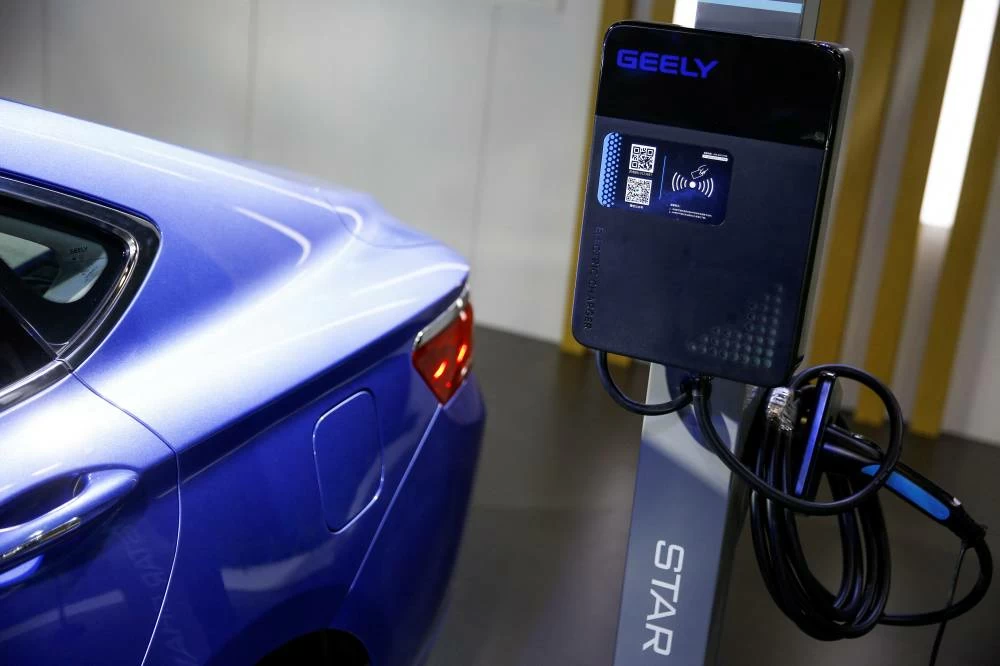
BEIJING: Chinese EV makers have another battleground in their quest for technological supremacy: ultra-fast charging.No longer satisfied with 30-minute top-ups, automakers such as Geely, BYD, and Li Auto are now racing to deliver charging speeds that mimic the 5-minute gasoline stop. That sprint to deliver extreme charging speeds has intensified as manufacturers seek to ease consumer range anxiety - and rekindle demand in the world's biggest car market, where growth has slowed.But pushing megawatt-level currents into lithium-ion batteries also poses severe engineering challenges, highlighting the risk of fire, battery degradation, and even the potential collapse of power grids.FILE PHOTO: The Geely logo is seen during the launching of Geely Auto France, in Paris, France, April 28, 2026. ReutersHow fast is fast?Chinese carmakers have raced ahead of Western rivals in charging capabilities.Geely on Wednesday unveiled an ultra-fast charging setup that boasts a specialised battery and peak output of up to 2.25 megawatts (MW) from a single charging gun. Geely said the system can charge an EV from 10% to 70% in 4.5 minutes, and from 10% to 97% in 8 minutes and 40 seconds at room temperature.Rival BYD has developed its own megawatt-level flash-charging systems and blade batteries capable of charging from 10% to 97% in 9 minutes.Li Auto's flagship electric vehicles are equipped with CATL's 5C Kirin battery, which can add up to 500 km (310 miles) of range in just 12 minutes.Battery maker Sunwoda joined the flash-charging race earlier this month with a battery system promising 10%-97% in 9 minutes.A standard 10% to 80% charge on a Tesla Supercharger usually requires 15 to 25 minutes, roughly double the time claimed by the latest Chinese systems. Mercedes-Benz offers fast charging from 10% to 80% in as quickly as 22 minutes.A close up of EV charging station at M-Smart production facility during organized media tour in Hohhot, Inner Mongolia Autonomous Region, China, June 11, 2026. (Reuters)What are fire and safety risks?A major hurdle in ultra-fast charging is managing intense heat and battery degradation.Rather than slowing charging speeds, Chinese carmakers are turning to advanced hardware engineering and artificial intelligence to keep batteries stable.To prevent hotspots, Geely introduced a full-loop "five-end" liquid cooling network that circulates fluid through the charging station's storage batteries, liquid-cooled cables, and to vehicle charging ports.Automakers are making certain EV battery cells shorter or adopting "short-blade" designs with less friction to keep the battery from overheating during mega-fast charging.Software is playing a role to address safety risks. Geely is deploying an AI technology with deep-learning algorithms running directly on the vehicle so it can anticipate temperature rises 30 seconds in advance.To combat battery wear from fast charging, automakers and battery manufacturers use different methods such as specialized coatings or high-frequency pulse currents.Picture credit: UnsplashWhat lies ahead?Despite the rapid technological advancements, charging speeds are already hitting a ceiling, one Geely executive told Reuters.He hinted at moving from speed competition to massive infrastructure installations to accelerate roll out of fast charging networks.To prevent power grids from collapsing under multi-megawatt charging demands, fast-charging stations are integrated with battery storage systems and solar power.BYD plans to build 90,000 flash-charging stations by 2028 and install 300 of those over the next year in the UK.Smaller rival NIO has over 4,000 battery-swap stations where a full battery replacement takes about three minutes.