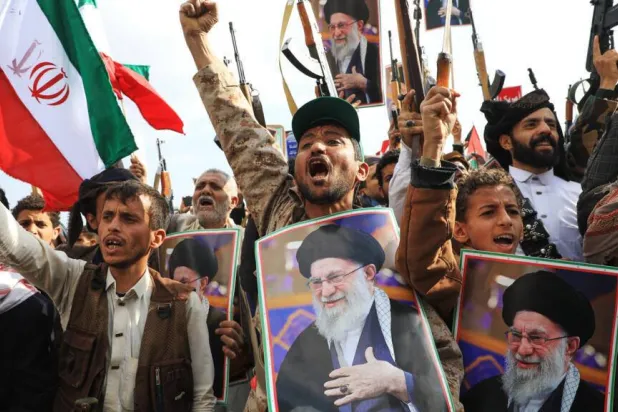
The Yemeni Ministry of Interior revealed Tuesday the presence of 21 foreign experts working with the terrorist Houthi militia, including 14 operatives from the Iranian Revolutionary Guard Corps (IRGC) and seven from the Lebanese Hezbollah, threatening the security of Yemen and international marine navigation and undermining regional and international security. Distributed across six Yemeni governorates, these experts handle funding, arming, training, direct supervision, and operational planning to build the militias' military capabilities. This runs parallel to political, organizational, social, and media activities designed to cement long-term influence and establish networks of loyalty aimed at "placing Yemen outside its Arab surroundings." The specializations of these foreign experts encompass operations management, command and control, ballistic missiles, drones, surveillance systems, communications, and electronic warfare, alongside overseeing supply lines and military component smuggling networks. Their expertise also extends to coordinating maritime operations, selecting commercial vessel targets, developing booby-trapped boats, engineering autonomous submarines, and training elements in mine-laying and urban warfare tactics for city sieges. A ministry statement said the operatives were working in Hodeidah, Sanaa, Saada, Hajjah, Amran and al-Kokha. They are led by a military figure from the Revolutionary Guard, “who appears before cameras as an ambassador for a state that claims to respect international law.” He serves as the general supervisor of operations, a strategic advisor, and the director of the joint operations room, alongside senior and mid-level officers specializing in drone workshops, smart missiles, and ballistic missiles, as well as naval experts and specialists in radar, communications, and electronic warfare. “These activities threaten the security of the region, the lives of mariners, and the freedom of navigation in Bab al-Mandab and the Red Sea, as well as trade routes and energy supplies,” said the statement. It warned “of the potential transfer of military expertise and technology to other terrorist groups that share the same extremist ideology.” It stressed the importance of the international community designating the Houthi militia as a terrorist organization, dismantling its financing and arming networks, and enforcing the arms embargo established under UN Security Council Resolutions 2216 and 2624. “What the Houthis possess in terms of decision-making is merely the microphone, as the decisions are written in Tehran, announced in Sanaa, and paid for in Taiz, Hodeidah, and the rest of the governorates,” it added. “The siege imposed by the terrorist Houthi militia on Taiz is one of the outcomes of this presence and support by experts from the IRGC and the terrorist Lebanese Hezbollah. It stands as evidence of the blatant presence, interference, and support for proxies in the region, which places the free world before a responsibility to stop these interventions and malicious acts,” it stressed. Addressing the people, Interior Minister Ibrahim Haidan said: “This war into which the Houthis are driving you under the pretext of supporting Palestine is not your war; rather, the Houthis merely announce it, while Iran is the one guiding it, and you are the ones paying its price.”