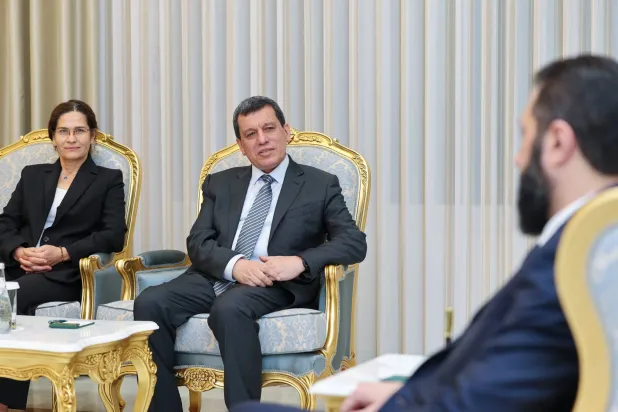
Syrian President Ahmad al-Sharaa has issued Decree No. 200 of 2026 appointing Ilham Hanan Ahmad to the People's Assembly to fill a vacant seat designated for an independent member, bringing the assembly's membership from 205 to 206, the legislative body announced Thursday. The decree is based on provisions of the Constitutional Declaration, particularly Article 24, as well as Article 45 of Decree No. 143. According to the assembly, Article 45 authorizes the president to appoint a replacement for any member who dies, resigns or loses their membership. People's Assembly member Mudar Wafiq Hamdan was removed from his position several weeks ago over his previous ties to the former regime, which had sparked public and media criticism. Ahmad's appointment brings the number of Syrian Kurdish lawmakers in the assembly to nine. The appointment comes months after the Syrian Democratic Forces (SDF) announced their dissolution as part of an agreement to integrate their structures into central state institutions. On March 10, 2025, President al-Sharaa and SDF commander Mazloum Abdi signed an agreement providing for a ceasefire and the integration of the Kurdish-led forces into Syrian state institutions. The agreement initiated a process to integrate Kurdish forces in the region, including the formation of a military division comprising three SDF brigades and a separate brigade for the forces of Ain al-Arab (Kobani), within a division affiliated with Aleppo province. In August, following a military escalation with Damascus, Abdi announced the dissolution of the SDF, whose backbone consisted of Kurdish fighters who had played a major role in combating ISIS. President al-Sharaa subsequently appointed him as an adviser. Since the agreement, several former SDF officials have been appointed to positions in the Syrian government. These include Abdi's appointment as presidential adviser on Kurdish affairs, Sipan Hamo (Samir Aso) as deputy defense minister for the eastern region, and Nour al-Din Issa Ahmad, also known as Abu Omar Khanika, as governor of Hasakah, alongside other appointments. The dissolution of the SDF marked the end of a significant chapter in the history of Syria's Kurds, who had hoped to consolidate self-rule and preserve the gains achieved during years of conflict. Ilham Ahmad was among the most prominent advocates of those aspirations. Born in 1972 in Afrin, northern Syria, Ilham Hanan Ahmad has spent decades playing a prominent role in advocating for Kurdish rights and women's political participation, both domestically and internationally. She began her political activism as one of the early advocates of women's rights at the University of Aleppo, where she studied Arabic literature. Ahmad later became one of the founders of the autonomous administration established by Kurdish groups after the outbreak of the Syrian conflict, which developed organized civilian and military institutions. She strongly advocated a decentralized, pluralistic system of government in Syria, a proposal firmly opposed by Damascus. Alongside Abdi, Ahmad became one of the principal negotiators with the central government, participating in talks that culminated in the signing and implementation of the integration agreement. The start of the agreement's implementation, which included provisions for the return of displaced Kurds to areas they had fled following Turkish military operations, enabled Ahmad to visit her hometown of Afrin in May 2026 for the first time in nine years.