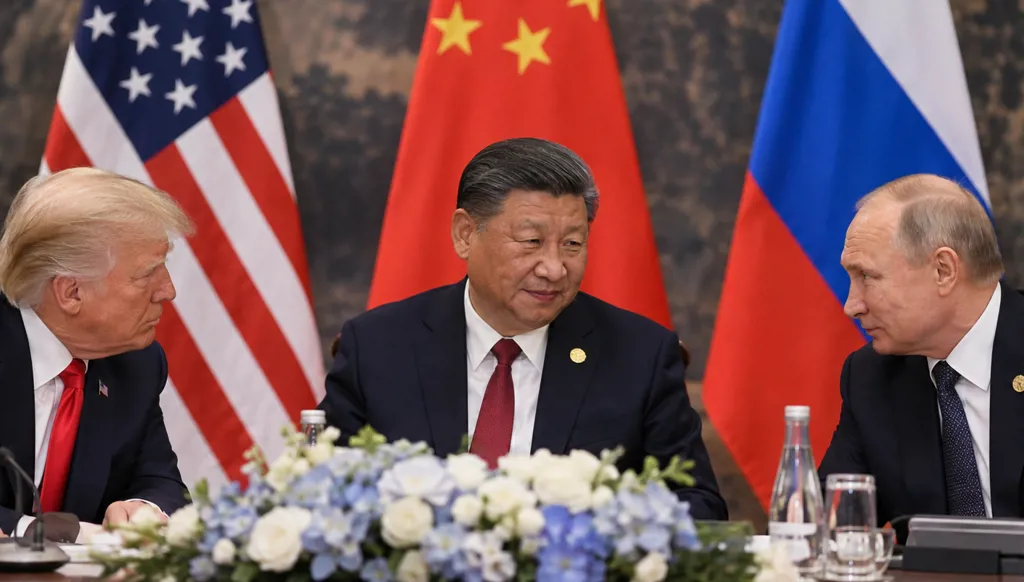
Mohamad Ali Hamadeh It was a rare scene: the presidents of China, the United States and Russia gathered around the same table, with Xi Jinping playing host. The atmosphere in Shenzhen seemed a far cry from the chill of Cold War encounters, from the Paris summit that collapsed over the U-2 spy plane incident in 1960 to the tense exchanges between John F. Kennedy and Nikita Khrushchev in Vienna a year later. Whatever comes of the meeting, its imagery is likely to reverberate around the world. But will the summit be remembered as a turning point in the international order, or merely as a symbolic gathering that yielded few tangible results?Beijing's diplomatic ambitions and the limits of a new world orderFor Beijing, the summit already represents a diplomatic achievement. By bringing the American and Russian presidents together on Chinese soil, Xi has positioned his country at the centre of discussions traditionally dominated by Washington. For Dr. Khattar Abou Diab, a Lebanese professor of international relations at the University of Paris, China's role as host was “a first” and “very important”. By taking the initiative, Beijing “claims a leading position, though not necessarily the foremost one”, he told Annahar. Regardless of its outcome, the gathering itself constitutes, in his view, “a historic moment”.Yet convening a historic summit does not necessarily mean reshaping the international order. For Dr. Abou Diab, “it is too early to speak of a new world order”. The emergence of a genuinely multipolar system, he argues, would require “greater efforts, as well as a system of global governance that is currently lacking”.The limits of this rapprochement were already evident in the summit's joint declaration. While the three leaders pledged to explore ways of reducing nuclear risks and preventing proliferation, they made no commitment to establish a timetable for future talks. The issue remains particularly sensitive for Beijing, whose nuclear arsenal is considerably smaller than those of Washington and Moscow, and which has long resisted entering such negotiations before reaching a more comparable position.Beyond nuclear security, the declaration also addressed United Nations reform and increased supplies of refined petroleum products. Conspicuously absent, however, were references to Ukraine, Taiwan and Iran, three of the most contentious issues dividing the protagonists. Rather than producing concrete outcomes, the summit may therefore be viewed as an effort to, as Khattar Abou Diab puts it, “manage their differences, ease international conflicts, and prevent those conflicts from escalating”.Iran at the centre of a potential US-China-Russia bargainThe implications of such an understanding, however, could extend well beyond the three powers, particularly to the Middle East, where China and Russia maintain close ties with Iran as Washington continues to threaten a full-scale war.For Ghassan Ibrahim, director of the UK-based think tank Trends, “the Iranian issue could become part of a broader bargain between Trump, Putin and Xi”. The central question, he argues, is “what Trump might offer Beijing and Moscow in exchange for their assistance in reducing tensions with Tehran”.China's economic leverage over Tehran could prove particularly significant. “The Iranian economy depends heavily on China's contribution”, Dr. Khattar Abou Diab notes, questioning whether Beijing might now be willing to discuss Iran with Trump “with greater transparency”, particularly given that it “supplies large quantities of military equipment”.Ghassan Ibrahim, meanwhile, suggests another possibility: “Xi could use Beijing's economic relations with Tehran to facilitate an understanding on navigation, and ask in return for an easing of American pressure on Chinese companies dealing in Iranian oil.”The Strait of Hormuz and Russia's leverage over TehranIbrahim believes “that any understanding is most likely to begin with Hormuz, where the interests of Washington and Beijing converge on the regular flow of maritime traffic, while a nuclear agreement requires Tehran's acceptance and verification arrangements”.The first indication of a genuine diplomatic bargain, he suggests, would be a shift from general discussions about stable energy supplies to negotiations over specific measures in the Strait of Hormuz, involving Iran and the relevant Gulf states.Abou Diab, for his part, believes the summit could ultimately “lay the groundwork for containing Iran and avoiding escalation in the region”.Russia, too, could seek to turn its influence over Tehran into diplomatic leverage. In this context, Dr. Abou Diab questions whether “what Trump can offer Putin on Ukraine could be a worthwhile trade-off for concessions Putin might offer Trump on Iran”.Ghassan Ibrahim identifies another potential bargaining chip: “Putin has an existing offer to receive Iran's enriched uranium, and he may seek to use any Russian role in settling the nuclear issue to improve his position in negotiations with Washington regarding sanctions”.