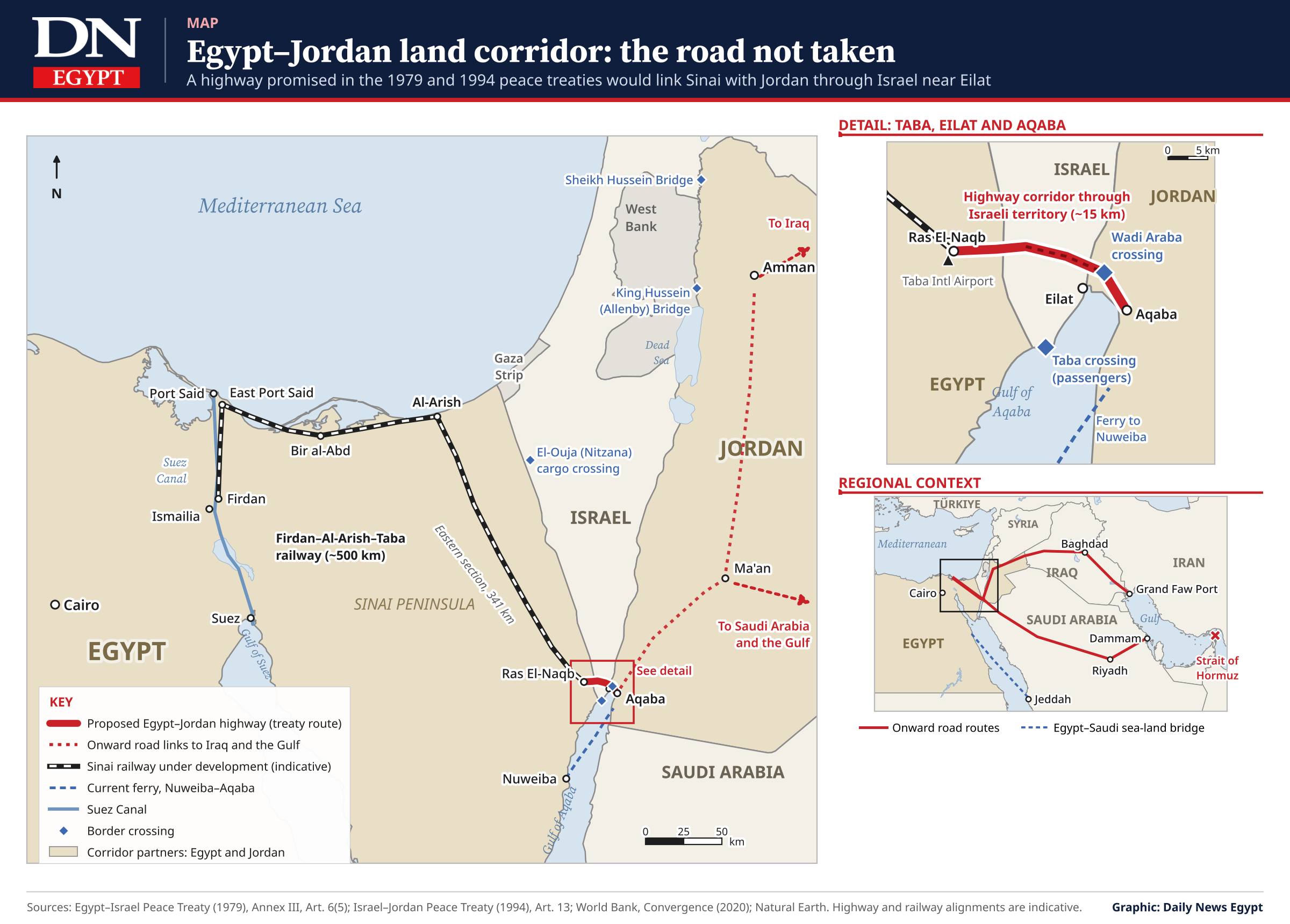
Two peace treaties envisaged a highway connecting Egypt and Jordan near Eilat. Nearly five decades after the original commitment, its strategic and economic potential deserves renewed examination, particularly as Egypt expands its roads and railway networks across Sinai and Gulf countries seek more resilient trade routes.
In 1979, when Egypt and Israel signed their peace treaty in Washington, the agreement’s significance extended beyond ending a state of war. Annex III, Article 6(5), of the 1979 Egypt–Israel Peace Treaty provides for the reopening and maintenance of roads and railways between the two countries and the consideration of additional connections. More specifically, it states that a highway “will” be constructed and maintained between Egypt and Jordan through Israel near Eilat, guaranteeing “free and peaceful passage” for persons, vehicles and goods.
Fifteen years later, the idea reappeared in the October 1994 Israel–Jordan Peace Treaty. While it did not repeat the 1979 treaty’s specific wording concerning guaranteed free and peaceful passage, it reaffirmed the obligation to pursue the project. Article 13, dealing with transportation and roads, committed the two countries to “resume negotiations” concerning a highway to be constructed and maintained between Egypt and Jordan through Israel near Eilat. The reference to resuming negotiations indicates that discussions had already taken place, making the prolonged absence of an operational connection all the more significant.
Revisiting the project should be assessed through the prism of Egypt’s role as a transport and logistics hub connecting Africa, Asia and Europe. It would also represent a significant step towards reconnecting Arab countries in North Africa and Southwest Asia. Sinai’s pivotal position and its developing road and railway infrastructure, alongside Egypt’s established ports and transport networks, give the country considerable scope to keep shaping regional connectivity.
The proposal deserves consideration alongside Egypt’s and Jordan’s wider transport strategies. Egypt is advancing the Firdan–East Port Said–Bir al-Abd–Al-Arish–Taba railway project, a network extending approximately 500 kilometres across Sinai. Its 341-kilometre eastern section connects Bir al-Abd, Al-Arish and Ras El-Naqb, near Taba Airport. The railway is intended to integrate Sinai’s residential communities, industrial zones and mining areas with the national network. Better connectivity could encourage investment in North Sinai, stimulate logistics services and industrial activity and improve access to employment and markets for local communities.
Recent disruptions to the Strait of Hormuz have highlighted the need for diversifying transit. A functioning road corridor could facilitate the movement of agricultural produce, manufactured goods, construction materials and consumer products between Egypt, Jordan, Iraq and Saudi Arabia. Egyptian exporters would gain an additional route towards Gulf markets, while Jordanian and Saudi businesses could benefit from improved access to Egyptian production centres and ports. Egypt and Saudi Arabia have been exploring alternative arrangements, including a sea-land bridge linking Egyptian ports with Jeddah and onward Gulf markets. Egypt’s development of international logistics corridors under the UN TIR road transport framework reflects a similar effort to expand regional connectivity.
Road transport would be particularly useful for certain time-sensitive shipments and larger consignments, complementing rather than replacing maritime freight. The Suez Canal will maintain its essential role in international maritime trade, while additional land connections could help Egypt capture further trade opportunities and strengthen the resilience of regional supply chains.
The arrangement envisaged direct overland movement between Egypt and Jordan through Israeli territory. From there, Jordan’s road connections with Iraq and Saudi Arabia could open an additional overland route towards the Gulf. Currently, movement between Egypt and Jordan across the Gulf of Aqaba relies heavily on maritime transport, particularly ferries linking Nuweiba and Aqaba. These services involve dependencies on sailing schedules, port handling, vehicle capacity and border procedures.
Iraq’s efforts to reconnect with its Arab neighbours and its Development Road project linking the Grand Faw Port to Türkiye reflect a renewed interest in the region’s overland geography. This has direct relevance for Egypt: bilateral trade between Egypt and Iraq reached approximately $1.1 billion in 2024, with Egyptian exports accounting for $816 million. These figures reflect an established commercial relationship that could benefit from more efficient regional transport connections.
Egypt and Jordan already have practical experience in managing different types of cross-border movements that could inform such an arrangement. Egypt’s management of the Taba crossing for passengers and the El-Ouja (Nitzana) crossing for cargo demonstrates how separate facilities can accommodate different regulatory and operational requirements. Jordan, meanwhile, manages three principal crossings with Israel: King Hussein Bridge (Allenby Bridge), Sheikh Hussein Bridge and Wadi Araba, handling passenger movements, commercial transport, customs and vehicle regulations. These experiences offer a useful institutional basis for developing coordinated procedures for the proposed corridor.
The World Bank examined the potential economic gains from improved regional integration in its 2020 report, Convergence: Five Critical Steps toward Integrating Lagging and Leading Areas in the Middle East and North Africa. Its analysis considered a scenario involving a 15-kilometre corridor through Israel, accompanied by improvements to border-crossing procedures. The modelling suggested that welfare gains for Egypt and Jordan would increase considerably when the physical connection was combined with shorter border waiting times. The implication is straightforward: the economic value of the project would depend as much on administrative efficiency as on the construction of the road itself. Customs procedures, vehicle regulations, insurance arrangements, cargo documentation and coordinated border operations all need to be addressed.
Equally important would be clear and legally binding arrangements guaranteeing steady transit conditions through Israeli territory. The 1979 Egypt–Israel treaty provision for guaranteed “free and peaceful” passage establishes a basis for predictable movement between Egypt and Jordan and is a key starting point for renewing negotiations. Several instruments address this principle, including the 1921 Barcelona Convention and Statute on Freedom of Transit and Article V of the General Agreement on Tariffs and Trade (GATT).
The principle of sovereignty must not become a pretext for obstruction or delays along the Israeli stretch of the highway. If access to the highway were to become subject to unilateral political or security decisions, Israel could use the ability to restrict or suspend transit as leverage. A route that is intended to strengthen regional trade and economic resilience must not become an instrument through which political pressure can be applied to neighbouring states. One solution would be to establish an internationally monitored transit framework. Such a mechanism would oversee compliance with agreed transit obligations, monitor border-crossing procedures, address disputes and provide transparency regarding any restrictions imposed on the movement of people and goods. Combined with clear procedures for addressing violations and disruptions, monitoring could help prevent the arbitrary interruption of transit.
It is obvious that a cross-border infrastructure project cannot be considered independently of the circumstances in the region. The Gaza war, the unresolved Palestinian question, Israeli policies in the occupied Palestinian territories and constant regional security threats have all affected the prospects for wider cooperation. While Cairo revives a land connection project linking Sinai with Jordan, it should also insist on reviving the right of safe passage between Gaza and the West Bank in accordance with the 1995 Oslo II interim agreement and the 1999 Protocol concerning safe passage. A transportation corridor linking Gaza to the West Bank is an essential component of the territorial continuity of a viable Palestinian state. The development of regional corridors must give equal consideration to Palestinian mobility and territorial integrity.
As yet, the highway remains confined to treaty provisions despite considerable changes in the region’s political, economic and physical geography. Reviving it merits serious consideration, supported by clear guarantees, effective enforcement and reciprocal benefits. With the 1979 Egypt–Israel Peace Treaty marking fifty years in 2029, the coming three years offer an opportunity to turn a longstanding but unrealised commitment into a functioning corridor. The first step should be for Egypt and Jordan to engage in direct bilateral consultations to explore the project’s potential and establish a shared vision for its implementation.Perhaps then, the road envisaged in the treaty will find its way onto the map.
Nadine Loza is a development strategist, opinion columnist, and Founding Director of the Egypt Diaspora Initiative.