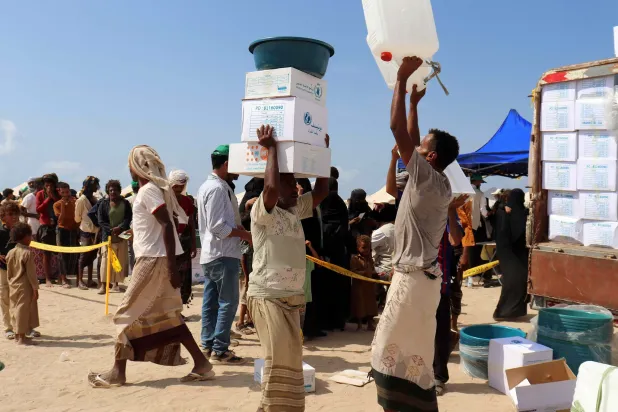
Yemen's food security crisis is worsening amid a Houthi military escalation, with declining food and fuel imports, rising prices of essential goods and eroding household purchasing power. Some 18.7 million people are facing acute food insecurity as displacement increases and humanitarian funding falls short. Recent indicators from the United Nations Food and Agriculture Organization (FAO) warn that continued conflict, supply chain disruptions, declining humanitarian assistance and climate pressures could push millions of Yemenis into more severe food deprivation during the final months of the year, with some areas at growing risk of reaching Emergency or Catastrophe levels. The data reveal a widening gap between people's food needs and their ability to obtain adequate supplies in a country heavily dependent on imports for basic necessities. Markets are facing simultaneous pressures from higher transportation and fuel costs and declining household incomes. According to the latest indicators, approximately 18.7 million people in Yemen, more than half the population, are experiencing acute food insecurity at Phase 3 or above under the Integrated Food Security Phase Classification (IPC). Conditions have deteriorated further amid escalating armed clashes and displacement, particularly in Taiz governorate, along the western coast and in conflict-affected areas of southern Yemen. These developments have placed additional pressure on essential services already struggling with limited resources, while host communities face growing demands from increasing numbers of displaced people. Field reports indicate that large-scale displacement, including more than 350,000 people forced from their homes within two months according to local data, is placing additional burdens on families and host communities while intensifying competition for scarce resources, jobs and services. Houthi restrictions on the movement of people and goods, along with disruptions to roads and maritime routes, have also slowed commercial shipments and increased freight and transportation costs. These pressures have driven up food prices and complicated the delivery of humanitarian assistance to the most vulnerable populations. Prices Outpace Household Incomes In a further indication of mounting pressure on living standards, prices of several essential food items increased in September. Flour prices rose 7.4% month on month, while rice prices increased 6.3%. Sunflower oil became 3.3% more expensive, and bean prices climbed 3.6%. The cost of the minimum food basket also increased by 2% compared with August, placing it 7% above its level a year earlier and 2% higher than the three-year average. These increases come as wages remain weak and workers struggle to keep pace with rising living costs. Wages for unskilled daily laborers declined 0.4% month on month and remained 9.7% below their levels a year earlier, while agricultural labor wages increased by just 0.4%. The impact was particularly evident in food purchasing power. The amount of flour that unskilled daily laborers could afford fell by 7.2% month on month and 23.1% year on year, highlighting the widening gap between household incomes and the cost of basic necessities. Wheat Imports Decline The pressures extend beyond rising prices and weak incomes to declining commercial supplies on which local markets depend. Recorded wheat and wheat flour imports fell 1.5% nationwide, while imports through ports controlled by the Yemeni government dropped 42.5%. The sharp decline at government-controlled ports provides further evidence of mounting pressure on essential supply flows, particularly given Yemen's heavy reliance on imports to meet its food needs. Gasoline and diesel imports also declined by 9.9%. However, the lack of data from Houthi-controlled areas limits the ability to assess overall fuel import trends across the country. Although official diesel prices fell 4.5% month on month, they remain significantly higher than levels recorded a year earlier and the three-year average. This continues to keep transportation and production costs elevated, adding further pressure to the prices of essential goods. These developments are particularly significant as trade, road networks and maritime routes continue to be affected by disruptions and restrictions. Higher shipping and transportation costs are being passed directly on to consumers at a time when households have increasingly limited capacity to absorb further price increases. Mounting Pressures Meanwhile, the Yemeni rial has shown relative stability in government-controlled areas, although its value remains 4% below the level recorded a year earlier and 8% below the three-year average. However, this relative improvement has not been sufficient to offset rising food prices and living costs or halt the decline in household purchasing power. Families continue to face overlapping pressures from weak wages and higher prices for goods and services. In the livestock sector, prices of local goats and sheep rose 1.6% and 2.4%, respectively, on a monthly basis. Nevertheless, prices remained below their year-earlier levels, limiting the ability of livestock-dependent households to rebuild their sources of income. These households are becoming increasingly vulnerable as climate shocks and erratic rainfall persist, alongside severe funding shortfalls in the humanitarian response. Together, these factors are compounding the risks facing communities that depend on agriculture and natural resources to meet their basic needs.