A common thread linked the Republican Party in the United States and Israel's Likud Party during their recent election campaigns: the ineffective use of stereotypes to stoke fear of Arabs and Muslims in an attempt to win voters' support.
During the campaign leading up to the U.S. midterm elections, many Republican politicians spent months appearing to operate without any moral restraints in their efforts to fuel fear of Muslims, both as candidates and voters, while questioning their loyalty to the United States.
Republicans drew on a deep reservoir of fear and suspicion towards Islam and Muslims, which had not diminished since September 11. More than half of the American public and 76 percent of Republicans said in a poll conducted a few months ago that they agreed with the view that "Islam encourages violence."
These hostile narratives reached their peak with Trump's attacks on Democratic candidate from Michigan, Abdulrahman (Abdul) El-Sayed, whom he labeled a "jihadist" who hates Israel and Jews. Nevertheless, the majority voted for "Abdul," making him the first Muslim senator in the United States.
Republicans also targeted candidates from the progressive wing of the Democratic Party, accusing some of being "communists" or of "encouraging anti-Semitism."
Yet this rhetoric did not prevent voters, including many Republicans, from voting overwhelmingly for the Democrats.
The weapon of fear and intimidation failed in America because the majority of voters cast their ballots for the Democrats in protest against the rising cost of living, driven by higher oil prices directly linked to the war in Iran, which most Americans opposed and continue to oppose.
The "oil shock" caused by the Iran War hit the Republicans, unlike the shock that followed the 1973 oil embargo. At the time, Arabs became targets of cartoonists and political commentators. This time, Washington bore full responsibility for the recent energy crisis, and the electoral cost was high.
American attitudes also shifted towards politicians who describe themselves as "socialists." Amid economic difficulties, calls to ease the financial pressures on citizens were no longer dismissed as "communist," and the accusation itself no longer carried the same weight it had during the Cold War.
A new generation of Democratic politicians emerged, unafraid to identify themselves as "socialists" without facing political marginalization. The election of New York Mayor Zahran Mamdani was a decisive indication of this shift in American attitudes. A poll conducted last September showed that 43 percent of Americans view socialism positively, with that figure rising to 57 percent among those aged 18 to 34.
Attitudes towards the relationship with Israel also shifted. According to Vice President JD Vance himself, this was among the factors behind the Republicans' electoral failure. Recent months have made it clear that criticizing Israel is no longer taboo and that U.S. support for Israel has become a burden on the White House and the Republican Party.
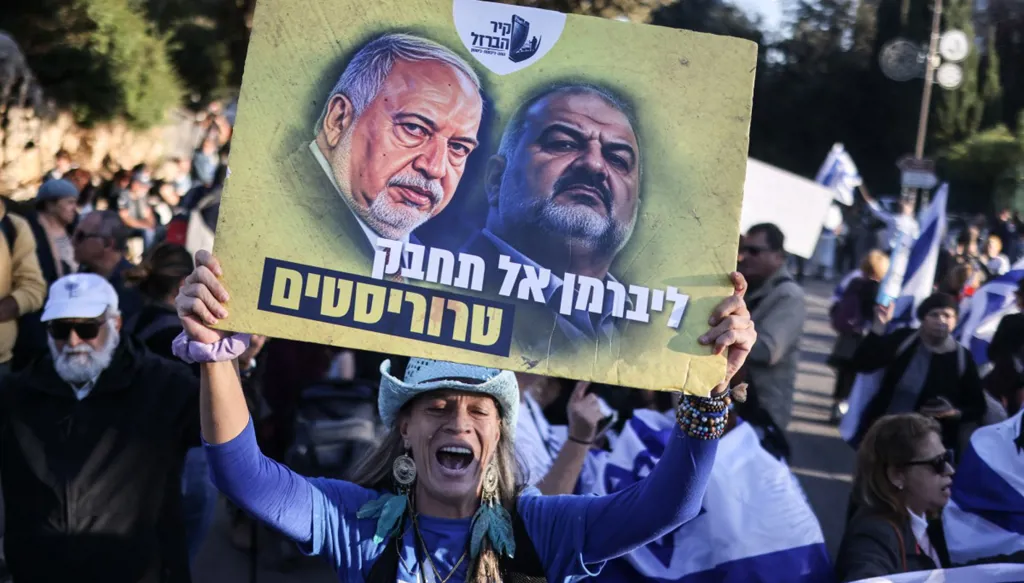
Netanyahu and his allies employed a similar strategy ahead of Israel's general elections, although the circumstances were different. Their campaign focused on exaggerating the "existential threats" they claimed the Jewish state was facing.
Netanyahu also portrayed the turnout of Arab citizens of Israel at polling stations as a threat to the country's security and Jewish identity, insisting that voting overwhelmingly for Likud was a "matter of life or death." He later accused Arab voters of "stealing" the elections in collusion with "foreign parties" in an attempt to "seize the Knesset and Islamize Israel."
However, the intimidation strategy failed to prevent Israeli Arabs from voting in record numbers. Their parties subsequently emerged as a significant factor in the process of forming the government coalition, for which Netanyahu ultimately failed to secure a mandate.
The American elections showed that the United States has changed. The situation is different in Israel, however, where fear and intimidation remain decisive political tools, constantly exploited by the right, particularly since Hamas's October 7 attack. This is unlikely to change in the near future.
America overcame the fear that followed September 11, with the elections ushering in a new chapter in its political history. Israel, meanwhile, deepened its own impasse and that of the region through the latest vote, as fear cannot lay the foundations for security or peace.
Disclaimer: The opinions expressed by the writers are their own and do not necessarily represent the views of Annahar.