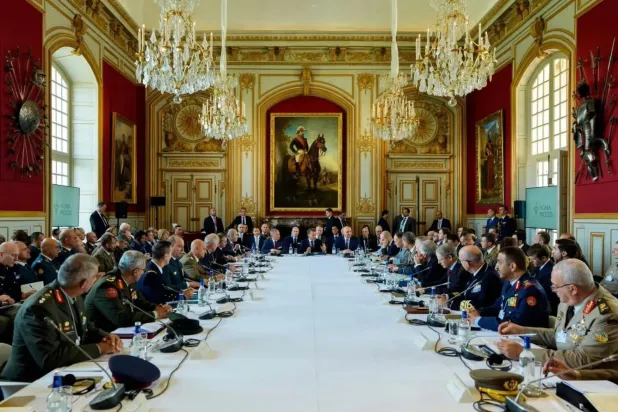
Senior officials and military officers gathered in Paris on Thursday to discuss support for the Lebanese Armed Forces and security services. French President Emmanuel Macron first met Lebanese President Joseph Aoun at the Elysee Palace before the two joined Jordan’s King Abdullah II for a trilateral summit at Les Invalides. The three leaders later opened a technical-military meeting attended by military commanders, chiefs of staff and senior officers from 17 countries and organizations. “Paris is today the place where our partners are coming together to strengthen Lebanon’s sovereignty and enable it to fully ensure its own security,” Macron wrote on X. “A Lebanon at peace offers renewed hope for the entire Middle East. A sovereign and stable Lebanon is a decisive step toward peace and stability across the region.” “Together with the Lebanese president and the king of Jordan, and in close coordination with the United States, Saudi Arabia and our international partners, we support the Lebanese Armed Forces, which are indispensable to asserting the authority of the Lebanese state throughout its territory,” he added. Turning to wider regional tensions, Macron argued that “diplomacy and dialogue alone” could end an escalation with no prospect of resolution. He reiterated France’s solidarity with Jordan and condemnation of Iranian attacks, while stressing the importance of freedom of navigation through the Strait of Hormuz, the Red Sea and the Bab al-Mandab Strait. Regional Dimension Aoun revealed measures taken by the state and urged support for its armed forces as an investment in regional security and stability. King Abdullah’s participation, within the framework of the Aqaba Process, gave the meeting a broader regional dimension. According to Lebanon’s National News Agency (NNA), citing presidential sources, the three leaders discussed the “dangerous regional situation” and stressed the need to intensify international efforts toward comprehensive and sustainable de-escalation. They also discussed developments in Gaza, the West Bank and Jerusalem. Aoun stressed the interconnected nature of regional security and called for a common regional security strategy based on joint energy projects and economic, security and political cooperation. The Lebanese president also sought to put behind him a period of strained relations with France, thanking Macron for France’s support for Lebanon and its efforts to strengthen state authority, sovereignty and official institutions. He praised Macron’s efforts, in cooperation with the Italian prime minister, to find an alternative to UNIFIL to prevent a security vacuum in South Lebanon, and called for broader economic and energy cooperation, including the resumption of oil and gas exploration in Lebanese blocks. ‘A Moment for Decision’ Aoun painted a bleak picture of conditions in South Lebanon because of Israeli attacks and practices, but said the country now had an opportunity based on “a clear determination to rebuild the state and its institutions and move forward with the reforms the country needs.” He said the goal was to establish “a strong state and effective institutions,” with the army and security services playing a central role. While emphasizing the importance of the state’s monopoly on weapons, Aoun insisted that this was “first and foremost a Lebanese choice and a Lebanese interest.” He also defended negotiations with Israel, warning that agreements succeed not merely by being signed but by being respected and implemented by all parties. He called on Lebanon’s “friends and partners” to help ensure the full implementation of what had been agreed and to treat Lebanon’s sovereignty and territorial integrity as a principle “not subject to selectivity.” Aoun detailed the army’s responsibilities, including extending state authority, maintaining security and stability, preventing border violations and combating smuggling. He also highlighted the role it would be expected to assume after UNIFIL’s mission ends to prevent a security vacuum. “There can be no strengthening of state authority without strong, effective military and security institutions present throughout Lebanese territory,” he underlined. The Lebanese president called for concrete results from the preparatory meeting, including a roadmap and clear timetable for an international conference to support the army and Internal Security Forces, as well as a long-term approach to assisting Lebanon’s security institutions. He pledged “full transparency and accountability” and said the Lebanese state would assume a growing share of financing its security institutions. “Invest in the success of the Lebanese state and in the stability of the region,” Aoun concluded. “This is a moment for decision, not a moment for waiting.”